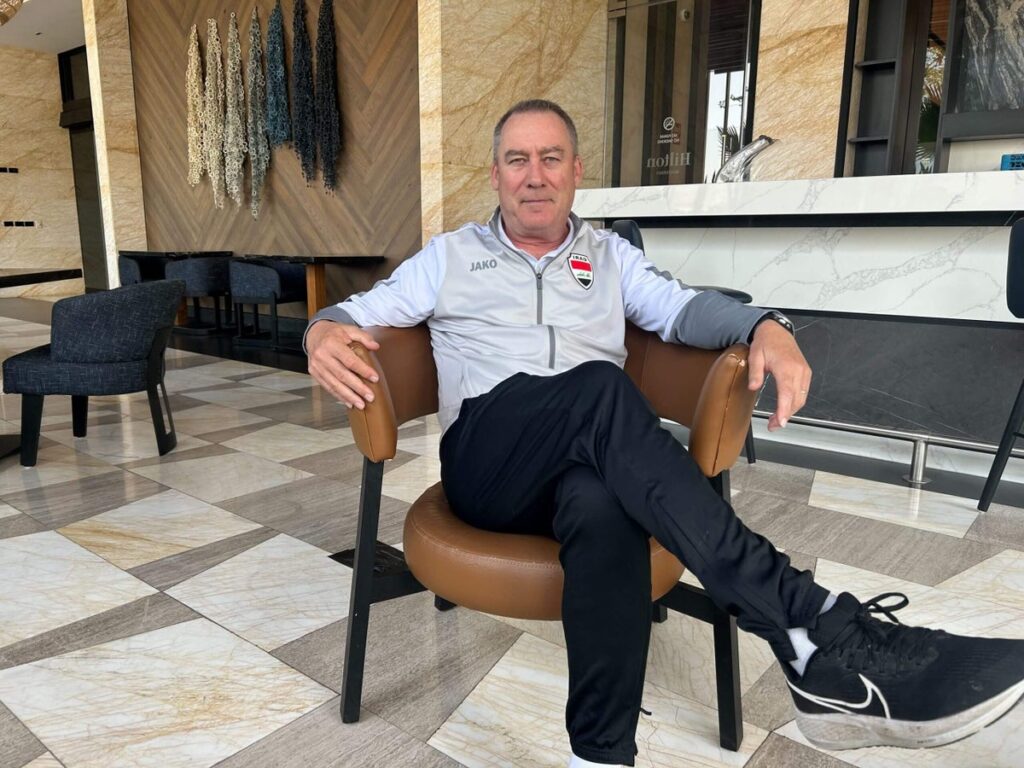

Iraq’s team hotel, to the south of Monterrey’s city centre, is tranquil and relaxed. It belies what is coming: a momentous play-off against Bolivia on Tuesday to decide who will become the 48th and final team to secure a place at this summer’s World Cup finals. Not since 1986 has Iraq been part of football’s biggest show.
“Honestly, if we qualify, you will see a nation erupting in joy,” Rene Meulensteen, the one-time Manchester United assistant manager now working alongside Iraq’s head coach Graham Arnold, tells The Athletic.
That uplifting prospect carries all the more meaning within a region now blighted by war. The ongoing US-Israeli strikes on Iran have seen its neighbours drawn into conflict, and northern Iraq, home to key strategic military sites, has been bombed by Iran for much of the last month.
The closure of airspace threatened Iraq’s participation in these intercontinental play-offs and eventually required players and staff to make a 550-mile bus journey from Baghdad to the Jordanian capital of Amman. Three days were spent in transit before eventually reaching Mexico via Lisbon last weekend.
It was an arduous journey for 90 minutes of football — but this Iraq team understand its significance. They have become flagbearers for a nation living through uncertain times and a place at the World Cup brings the promise of something more.
“It would mean so much,” says Meulensteen. “It would give us the opportunity to use that positivity and energy to change the perception of Iraq. A lot of people in the Western world think of Iraq and still the first thing that comes to mind is war.
“You have to see through that (image). It’s a country that’s gone through many, many years of hardship and they are gradually finding their feet. It’s a country that’s still dealing with the aftermath and there’s still a lot to be done, but you can see the outlines of what they want it to be. They want a normal life.”

Iraq fans in Basra support their team during a World Cup qualifier against the UAE (Tiba Sadeg/Middle East Images/AFP via Getty Images)
The last month has not been that. It was at the end of February that the first attacks were launched on Iran, and the ripples of retaliation have been felt across the region. Iraq, which neighbours Iran to the east, has found itself caught in the crossfire, with drone and missile attacks targeting American interests and oil fields.
Northern Iraq is also home to Kurdish Iranian dissident groups, some of whom have expressed eagerness to join the fight. Those groups have also been targeted by Iranian bombs over the last month.
Iraq has no apparent wish to be drawn into conflict 15 years after the Iraq War, a protracted battle that began with a U.S. invasion in 2003, but the threat to stability is there. Iraq remains reliant on its oil reserves and the prospect of a financial crisis lingers if exports are not able to resume through the Strait of Hormuz.
If that troubled landscape makes football seem inconsequential, the determination of the Iraqi-based players to make it to Mexico has served to underline the emotional value of this play-off final.
There had been an initial proposal from Arnold to postpone the fixture until the weeks that precede the World Cup, with it first thought that the only route out of Iraq was a 25-hour bus journey to Istanbul, Turkey, for the majority of the squad.
Talks with FIFA eventually led to a different plan being drawn up and, after having Mexican visas processed in Doha and Riyadh, due to the absence of an embassy in Iraq, they were cleared to travel to Amman, where airspace has been interrupted but open.
“All in all, they must’ve travelled for about three days,” says Meulensteen, who was at his home outside of Manchester when the first bombs fell. It is routinely the Dutchman’s task to monitor Iraq’s European-based players, including Luton Town’s Ali Al-Hamadi and former Manchester United youngster Zidane Iqbal, who is now with Dutch club Utrecht

One of Meulensteen’s responsibilities is to monitor the form of Zidane Iqbal (Karim Jaafar/AFP via Getty Images)
Arnold was less fortunate. The veteran Australian coach had travelled to Dubai to watch his star striker Mohanad Ali turn out for Dibba in the UAE Pro League and found himself stuck there until March 10, when able to fly on to Zagreb, Croatia.
“You’re always fearful for your players and staff because it is hard to follow what is going on,” says Meulensteen. “It has been such an uncertain time. We would stay in touch with one of the staff members and he would give us updates.
“Luckily, Iraq has not gone into a full-scale retaliation (against Iran) because then you would have a completely different scenario.”
Did Meulensteen ever fear the play-off final would not go ahead?
“Oh yeah, definitely,” he says. “We were having regular meetings to discuss what was happening and, as you know, Graham spoke about postponing the game to be played just before the World Cup. It became evident that FIFA was keen to get these games played, which is understandable.
“It’s a shame that a worldly, political issue interferes with something that should be the biggest sporting event in the world, where everyone can compete and unite. It’s an awful situation where we still don’t know what is going to happen — FIFA included.”
The doubts over Iran’s participation have brought another element of flux for Iraq. They, in theory, could have been the beneficiaries of Iran’s withdrawal from the World Cup as the next best team to come through the Asian Football Confederation (AFC) route.
“You get mixed messages but I can understand the comments Iran has made about it being difficult to come and play in a World Cup that is hosted by a country that is attacking them,” says Meulensteen.
“That’s common sense. I feel for the Iran players. They have always had a strong national team, representing themselves really well. I don’t think sport should ever be influenced by politics. People use it a lot as a vehicle but it shouldn’t be. Hopefully, we will see an end to it before the World Cup.”
Iraq, though, want to reach this summer’s tournament on merit. It was in Mexico, for the 1986 finals, that they were last at the top table, losing all three games against the hosts, Belgium and Paraguay. Winning the Asian Cup in 2007 has been one of the few joys across four difficult decades since. Thousands in the Iraqi diaspora are expected in Monterrey, hopeful of seeing history.
“Football has a massive role to play for Iraq,” says Meulensteen. “It could bring so much more than just the pride and fulfilment of Iraq being able to go and represent themselves.
“Everyone in Iraq will walk with a spring in their step and open up so many other opportunities economically.
“Iraq, from a football point of view, still needs a lot of investment to get better facilities and stadiums. The resources are already there for talent; they just need to get an opportunity to get into clubs with good organisation and training.
“Then it’s up to the FA to create those elite pathways for under-age teams into the national team. Going to the World Cup would be a massive help.”
The game that brought Iraq this far is still enough to paint a broad smile across Meulensteen’s face. A two-legged showdown against the UAE in November would take its winners to Mexico, and little could split the two teams until Iraq were awarded a penalty 17 minutes into additional time.
“The noise was incredible,” says Meulensteen, recalling the moment Amir Al-Ammari converted the spot-kick to give Iraq a 3-2 victory on aggregate.
“Scoring that winner so late was unbelievable. That’s when everyone felt what it means for the Iraqi people.”
There were more than 62,000 of them inside Basra’s International Stadium for that decisive second leg, with street parties across the nation extending into the following day.
The moment also underlined the appeal of international football to Meulensteen, who has spent the last seven years assisting Arnold, first with Australia and now Iraq. Not since a brief spell in charge of the Indian team Kerala Blasters ended has Meulensteen been caught in the swell of club football, which once gave him a rake of silverware with Manchester United.

Meulensteen and Arnold during their time in charge of Australia (Robert Cianflone/Getty Images)
“I just love it,” he says. “I think for 99 per cent (of the time) it’s the purest form of football that exists. There are no agents involved, no contracts, and you have to pick the best players available.
“I’ve loved every minute of it with Australia and now Iraq. Club football, like the success we had at Manchester United, was a marathon, but this is intense, short periods. At my age now, it suits me well.”
There is an obvious bond with Arnold, too. They successfully guided Australia to the 2022 World Cup in Qatar, beating Denmark and Tunisia in the groups before narrowly losing out to eventual winners Argentina in the last 16. Iraq has presented fresh challenges for the pair, who were first introduced to each other by Sir Alex Ferguson when Meulensteen had been working as Manchester United’s assistant manager.
“Graham came to us as part of his Pro Licence,” he says. “He came for a week and I remember Alex Ferguson saying we’ve got this Australian lad coming and he’s actually played football in Holland. Did I know him? I knew of him because I knew him as a player, one of those hard-nosed strikers.
“Alex Ferguson asked me to look after him a little bit before and after training, and we hit it off straight away. At one point, I brought him home and the guard came down to show more of the person. Then you see how much you are alike.
“We stayed in touch after that and he’d ask me about certain players. He rang me in 2018 and asked if I would join him with the Australia team. One of my ambitions was always to go to a World Cup, so I wanted that chance.”
Meulensteen has still seen more than most in football. A managerial career that included spells in Qatar, Denmark, Russia, Israel and India straddled his golden years as Ferguson’s final assistant at Manchester United and a stint in charge of Fulham.
Experiences are vast but another World Cup, this time with Iraq, would bring satisfaction after joining Arnold’s staff last May.
“We’ve come a long way,” he says. “Culture is the biggest thing for us. Making sure we create a really great culture. That’s key. The players are great together, you see it at breakfast, lunch and dinner.
“There’s a good energy around the place. On the football side of things, we have structures that are better defensively and we’ve changed the attitude to be far more on the front foot. And we want them to be more comfortable on the ball, playing a certain way. That’s not always coming off in the way we want it, but we’re heading in the right direction.
“We know our biggest job is still ahead of us.”