
This is the 19th article in a series by The Athletic looking back at the winners of each men’s World Cup.
Previously, we’ve looked at Uruguay in 1930, Italy in 1934 and again in 1938, Uruguay in 1950, West Germany in 1954, before a Brazilian double in 1958 and 1962.
Next came an England success in 1966, another Brazil win in 1970, a second West Germany triumph in 1974, Argentina’s first win in 1978, Italy’s third in 1982, Argentina’s second in 1986, West Germany’s third in 1990, Brazil’s fourth World Cup in 1994, before France joined the party on home soil in 1998.
In the 21st Century, Brazil celebrated an unprecedented fifth title in 2002, then Italy won a fourth in 2006. Now, it’s time for a new name on the trophy…
Introduction
Amid the focus on the winter climate and the vuvuzelas in South Africa, perhaps the most important theme of the tournament was the ball. While it had become common for goalkeepers to complain about new footballs ahead of the World Cup, this was the first tournament where outfielders seemed disgusted, too. The lack of panels on the Jabulani, and therefore the lack of ‘drag’, meant long passes became even longer, shots from range were launched miles over the bar, and the general quality of play was poor.
Spain, though, seemed largely unaffected — partly because they were completely committed to short passing.

Franz Beckenbauer and David Beckham launch the Jabulani in December 2009 – it would not prove a popular model (Shaun Botterill/Getty Images)
The manager
Taking over from Luis Aragones, who had guided Spain to Euro 2008 success in spectacular style, was a tough task. But Vicente del Bosque had a great track record as a club manager, having won two league titles and two European Cups.
The slight complication was that the calm, unflappable Del Bosque was a true Real Madrid man. He spent his entire playing career with them, aside from loan spells, and subsequently worked as a youth team coach, assistant and caretaker manager before being given the top job. He’d also endured a disappointing season with Besiktas, but in Spanish football terms, Del Bosque was all about Madrid.

Del Bosque was a Real Madrid man, but got a tune from several Barcelona players in South Africa (Mustafa Ozer/AFP via Getty Images)
This Spain, though, were based around Barcelona players — even more so than at Euro 2008, considering Pep Guardiola had now established Barca as the dominant side in Europe. Del Bosque, therefore, had to play the role of politician as much as tactician. Arguably, his Madrid roots actually made it easier for him to select a primarily Barcelona side.
“I wanted, as a national coach — you may call this utopia — to make Catalans and Basques feel good about supporting a Spanish side,” he said in a 2012 Guardian interview. “To unite even the most sectarian and nationalist. The thought of using football to help unite us is something that makes me feel happy.”
While there would later be tensions between Barcelona and Real Madrid players — particularly after Jose Mourinho took charge of Real Madrid and the sides seemed to play each other every month — at this point, Spain were a very harmonious squad, and Del Bosque constantly stressed the importance of off-field harmony, as much as on-field cohesion.
Tactics
Pass, pass, pass. Passing at the expense of dribbling, of progressing the ball, and of optimum team shape.
Spain had a more distinct identity than any World Cup winner in history, a commitment to retaining possession that went beyond anything before it, and isn’t so viable these days in the age of heavy pressing. In a World Cup when only they and Chile looked to press in the opposite half — despite the cold winter climate in South Africa — Spain were often allowed to dominate midfield, with opponents concentrating on minimising their effectiveness in the final third.
Del Bosque’s initial approach featured Andres Iniesta and David Silva on the flanks, drifting inside into central positions. This resulted in a dreadful performance in a 1-0 defeat by Switzerland in their opening match, with Spain lacking any width or penetration. From then, Del Bosque omitted Silva — an unfortunate fall guy — and used a more direct player out wide. Initially, this was David Villa, with Fernando Torres up front, then later Villa moved to the No 9 position and Barcelona’s Pedro Rodriguez came into the side after only one season as a regular at club level.
Despite the side being dominated by Barcelona players, Del Bosque didn’t replicate their system. Rather than Barca’s 4-3-3, this was a 4-2-3-1. Sergio Busquets, Xavi Hernandez, Iniesta, Pedro and Villa (who joined Barca shortly before this tournament) would form five-sixths of the midfield and attack for both Barca and Spain. Essentially, the ‘swap’ was Xabi Alonso instead of Lionel Messi, which underlines Spain’s overwhelming commitment to midfield dominance.
🥳 A key player in Spain’s 2010 #WorldCup winning side where he started every game in the tournament 🏆
🇪🇸 Feliz cumpleaños @XabiAlonso 🎂#HBD | @SeFutbol pic.twitter.com/BjtITS2u5A
— FIFA World Cup (@FIFAWorldCup) November 25, 2021
Xavi disliked playing in the No 10 role and spent his time coming deeper into his usual position. Iniesta wasn’t entirely happy out wide. They lobbied Del Bosque to change the system without success. And therefore, while Spain’s style is easier to define than any other World Cup winner, the side lacked the understanding and interplay that made Barcelona so thrilling.

You might be surprised to learn
Spain only scored eight goals in their seven matches — none of which were scored by their starting No 9.
Villa scored five times, all in the four matches in which he started out wide. Iniesta scored two of Spain’s other three, while Carles Puyol headed home the only goal in the 1-0 semi-final victory over Germany.
For all of Spain’s focus on possession play, which tired the opposition, their breakthrough was generally provided by more direct players coming off the bench. Fernando Llorente, an old-school No 9, had a positive impact in the 1-0 second-round win over Portugal, while direct winger Jesus Navas and the free-running midfielder Cesc Fabregas played a major part in the only goal in the final.

Squad players such Fernando Llorente (left) played their part in Spain’s World Cup win (Jamie McDonald/Getty Images)
Not only did all four of Spain’s knockout matches against Portugal, Paraguay, Germany and the Netherlands finish 1-0, they were all goalless after an hour.
The star man
Of all the World Cup winners, this is probably the most difficult to determine, as it was a true collective effort. You could make a case that Villa, with five goals, was the star. Iniesta took control of the final and was a deserved matchwinner. Xavi seemed capable of dominating the midfield zone in every game, despite not playing in his favoured position.
Villa finished the highest among the Spain squad in the Golden Ball voting at the end of the tournament, although he was only in third place behind Uruguay’s Diego Forlan and the Netherlands’ Wesley Sneijder. That seemed fair; those sides were dominated by one superstar, whereas Spain were a proper team featuring several world-class players in their peak. They were not defined by a star man, but by not having any weak links.

This World Cup win was very much a collective triumph (Karim Jaafar/AFP via Getty Images)
The final
Going into the final, it was depicted as a festival of Cruyffism; two sides that were based around Ajax and Barcelona principles, and indeed players who had come through at those clubs.
But the Netherlands couldn’t truly match Spain’s midfield dominance. Their solution was to be ultra-aggressive, epitomised by Nigel de Jong’s shocking studs-on-chest ‘tackle’ on Alonso, a challenge English referee Howard Webb later admitted should have been punished with a red card.
Eight of the 10 Dutch outfielders were cautioned — the surprise was that it took 109 minutes for any of them to receive a second booking. Eventually, John Heitinga was dismissed, and at that point, a ragged Dutch side folded.

The Netherlands adopted a robust approach to the 2010 final (Pierre-Philippe Marcou/AFP via Getty Images)
But their approach had nearly worked. They arguably had the best two chances at 0-0, when their lightning-fast right-winger Arjen Robben ran in behind. On the first occasion, from a Sneijder through-ball, he was denied by Iker Casillas’ outstretched right leg. On the second occasion, Robben (somewhat uncharacteristically) elected to stay on his feet when Puyol tugged him back, allowing Casillas to intervene.
🤩 Made a stunning save from Robben
🧤 Won the Golden Glove
🏆 Lifted the #WorldCup Trophy🗓️ 11 July 2010 is a day Spain captain @IkerCasillas will never forget 🇪🇸@SeFutbol | #OnThisDaypic.twitter.com/ZCKFnRfSDb
— FIFA World Cup (@FIFAWorldCup) July 11, 2021
Spain were the better side in extra time, however. Iniesta, quietly effective throughout the tournament, stepped up and became the main man. He quickened attacks, skipped away from challenges, and created an excellent chance when he slid a through-ball in behind for substitute Fabregas, whose shot was saved. The roles were reversed for the winner.
The defining moment
Iniesta was perhaps the most popular player in world football at this stage: an artist on the pitch, a humble man away from it. He was not a prolific goalscorer but tended to pop up with crucial goals at the biggest moments. Four minutes from the end of extra time in the final, after Fabregas played him in, Iniesta controlled the ball, waited for it to bounce, and then thumped it home.
“That moment was magical,” Iniesta later said. “To win the World Cup and have the chance to score the winning goal, there’s no way to describe it. To finish it the way I did was a dream. It was history.”
The scorer of a #WorldCup Final-winning goal turns 35 today 🤩
Feliz cumpleanos to the one and only Andres Iniesta 🙌@andresiniesta8 | @SeFutbol pic.twitter.com/csWq3zxJje
— FIFA World Cup (@FIFAWorldCup) May 11, 2019
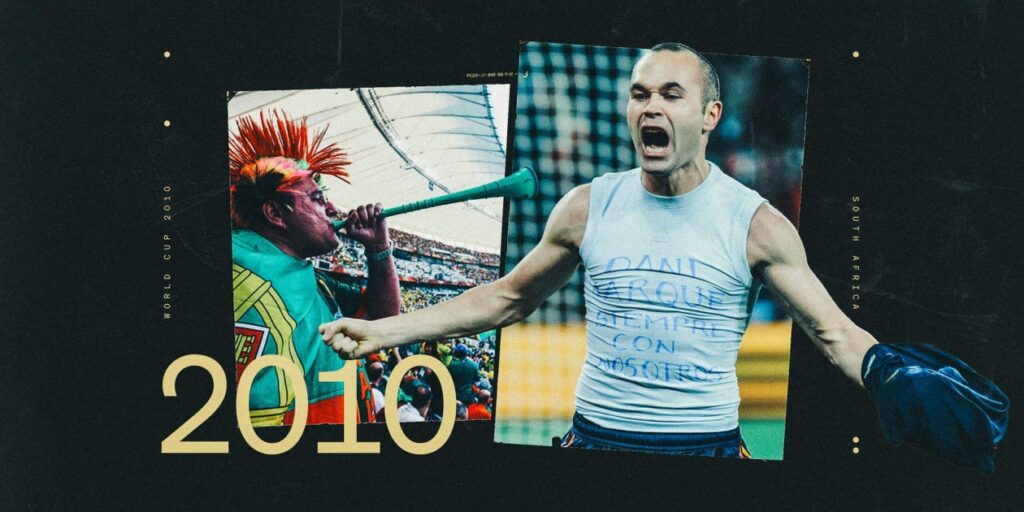
His celebration was also memorable. Iniesta whipped off his shirt to reveal a message dedicated to his close friend Dani Jarque, the Espanyol captain, who had suddenly died at the age of 26 the previous year.
Later, his team-mates would all take off their shirts, too — swapping the blue shirts they wore in the match in favour of red ones for the trophy presentation.
Were they definitely the best team?
Until they collapsed midway through the quarter-final against the Netherlands, Brazil looked the most resilient side. Germany, meanwhile, produced the most memorable performances of the tournament, sticking four goals past both Argentina and England, largely with counter-attacking football. In the semi-final against Spain, however, they looked limited, and would use that experience to become a more well-rounded side ahead of the next World Cup, improving their pressing and possession play.

For obvious reasons, the 2010 World Cup is remembered more fondly in Spain than elsewhere (Miguel Riopa/AFP via Getty Images)
In a way, Spain never quite seemed to click, and for all their possession, there were few examples of them unlocking the opposition with combination play. They were distinctly less attacking than when winning Euro 2008, and didn’t produce a single performance in South Africa that could be described as exceptional. Their control of matches was really a defensive ploy — four clean sheets in four knockout matches meant they only ever had to score once.