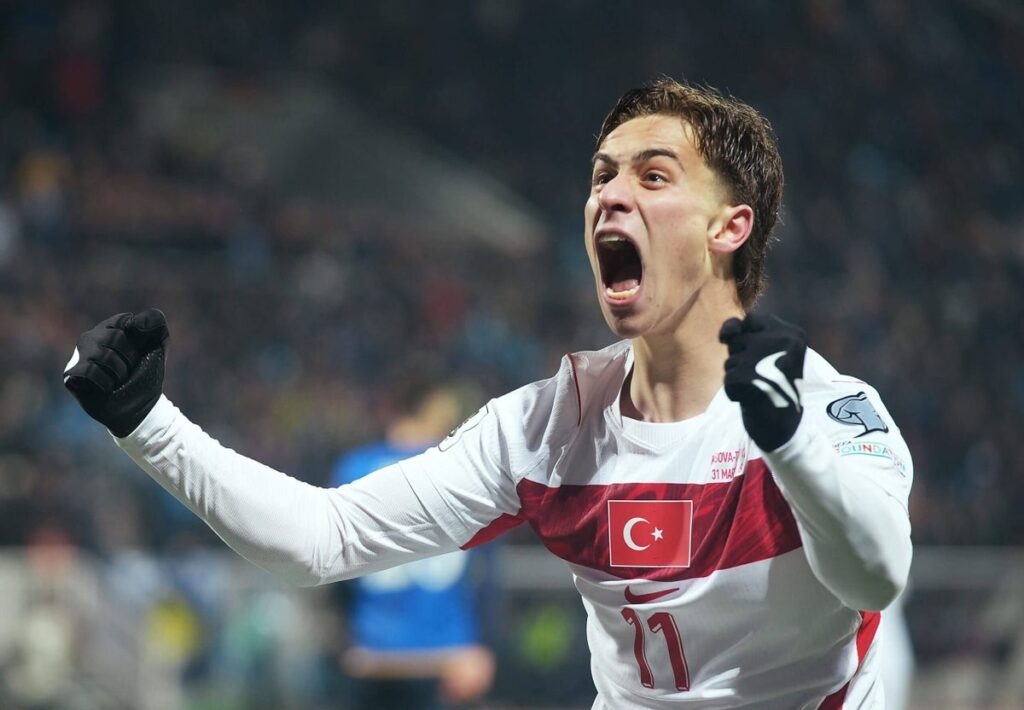

On a night of tension and drama in Pristina, Turkey qualified for their first World Cup in 22 years thanks to a second-half goal from Kerem Akturkcoglu. They take the final place in Group D this summer, where they will face the United States, Paraguay and Australia.
The driving rain at the Fadil Vokrri stadium could not dampen a febrile atmosphere but it ended in heartbreak for a brave Kosovo side, whose quest for a first World Cup final appearance continues.
Despite the partisan home support, Turkey started the game the stronger but it was Kosovo who came closest to scoring first when a powerful shot from Fisnik Asllani was pushed onto the crossbar by goalkeeper Ugurcan Cakir. Vedat Muriqi could not get clean contact on the rebound.

Fisnik Asllani’s shot was saved onto the crossbar in the first half (Armend Nimani / AFP via Getty Images)
Less than 10 minutes into the second half and Turkey took the lead. Kenan Yildiz drove down the left and squared the ball for Orkun Kokcu whose mishit shot was touched in at the far post by Kerem Akturkcoglu. The Kosovo players appealed to English referee Michael Oliver for offside but the goal was checked by VAR and allowed to stand.
Turkey wasted chances as they sought a second, ensuring a tense final 20 minutes. Kosovo’s Florent Muslija almost found the bottom corner with a shot from outside the box and Asllani forced another good save from Cakir with four minutes left. Turkey, though, held strong and will be heading to the U.S., Mexico and Canada this summer.
Felipe Cardenas, Greg O’Keeffe and Anantaajith Raghuraman discuss the main talking points.
Should the U.S. be worried by Yildiz and Guler at the World Cup?
Well, the US will end their group stage campaign against a very dangerous Turkey side. If the Americans enter that match needing a result, the collective anxiety across the 50 states will certainly be magnified. Turkey is traditionally an inconsistent team whose results don’t always align with their individual quality and expectations.
But the US will not be one to take them for granted. Names like Hakan Calhanoğlu, Arda Guler and Kenan Yıldız compliment a well-drilled outfit led by Italian manager Vincenzo Montella. Real Madrid No.10 Guler and Juventus attacker Yıldız in particular elevate the creative qualities of Turkey. Guler, 21, and Yıldız, 20, are now two of the World Cup finals most intriguing young players.

Arda Guler will be a player to watch at the World Cup (Armend Nimani / AFP via Getty Images)
Against Kosovo, Turkey was the dominant team in every statistical category. And it was Guler and Yildiz who provided the creative spark for the Turks. Güler has freedom to roam in midfield, whether he’s initiating a build up play or finding a dangerous pocket in the final third. The young playmaker is a player that the American midfield will have to account for. Yıldız, meanwhile, is a one-versus-one forward who has a relentless appetite for goal. He will be a problem for a US backline that remains unsettled.
Felipe Cardenas
How did Turkey unlock Kosovo?
It became evident early on that Turkey and Kosovo used similar out-of-possession set-ups.
Both teams pressed with two up top and two banks of four behind them, aiming to cut easy passes into midfield in the early build-up phase. As the ball went wide, that triggered the press from full-back and wide midfielders, resulting in limited space to operate in.
Turkey’s solution to this was to get Orkan Kokcu, who started as a No 10, to drift over to the left, with Ferdi Kadioglu inverting into midfield to isolate Yildiz against his marker. This helped them advance into good positions but Kadioglu stayed conservative in the first half, which left Yildiz to often chase after long balls.
In the second half, Kadioglu played higher up the pitch while underlapping Yildiz, often forming a triangle on the left with the Juventus forward and Kokcu. Turkey could play shorter passes and pin Kosovo back, resulting in better quality chances and more space between the lines.
For the goal, Kadioglu stayed wide, which allowed Kokcu to drop between the lines in midfield and find Yildiz, who beat his man and cut the ball back. Kokcu miscued his shot but Akturkoglu could steal in at the backpost to score.
Turkey controlled the period immediately after the goal using that same left-sided axis, with Arda Guler also drifting over to that side to provide an extra passing option. Ultimately, that — and some excellent saves from goalkeeper Ugurcan Cakir — proved the difference in a tight match.
Anantaajith Raghuraman
What was the atmosphere like in Pristina?
It started with a bang, or rather scores of bangs, across two salvos of ear-splittingly loud fireworks which lit-up the darkness when they were unleashed outside Turkey’s hotel at 1am the night before the game.
Pristina extended a warm welcome for Turkish supporters, but the hospitality did not stretch to a good night’s sleep for their team. The home fans tried for any edge they could lend their underdog side in this historic attempt to reach their first World Cup.
The atmosphere built-up early for what was arguably the most consequential sporting event in Kosovan history.
By 8am workers were preparing the central Zahir Pajaziti square, named after a commander of the Kosovan Liberation Army. A giant TV screen was erected for the thousands of supporters who would not get a seat in the 13,000-capacity Fadil Vokrri Stadium.

Kosovo fans gather ahead of the game (Armend Nimani / AFP via Getty Images)
Others perched on the balconies of apartment blocks facing the square for a better view of the big screen.
Delivery vans dropped off crates of the local Peja beer for those who flocked to the centre to bang drums, sing patriotic songs and wait nervously for kick-off.
They were all desperate for their team to make it a tournament in the U.S., in part because many in the country still have deep affection for its role in Kosovan history. Pristina has a Bill Clinton boulevard, a statue of the president, and one of the folk songs blasted out before kick-off was “Thank You, USA”. It’s all inspired by the Clinton administration’s lead role in NATO’s decisive 1999 intervention in the Kosovo War.
Their brave first-half performance raised hopes even further. When Fisnik Asllani’s shot was touched onto the bar by Ugurcan Cakir, the decibel levels were as loud as those early fireworks.
However, the longer the game went on, the more Turkey began to dominate. There was a late rally that briefly raised local hopes, but it was not to be. Kosovo will be back, but this was a night of heartbreak in Pristina.
Greg O’Keeffe


