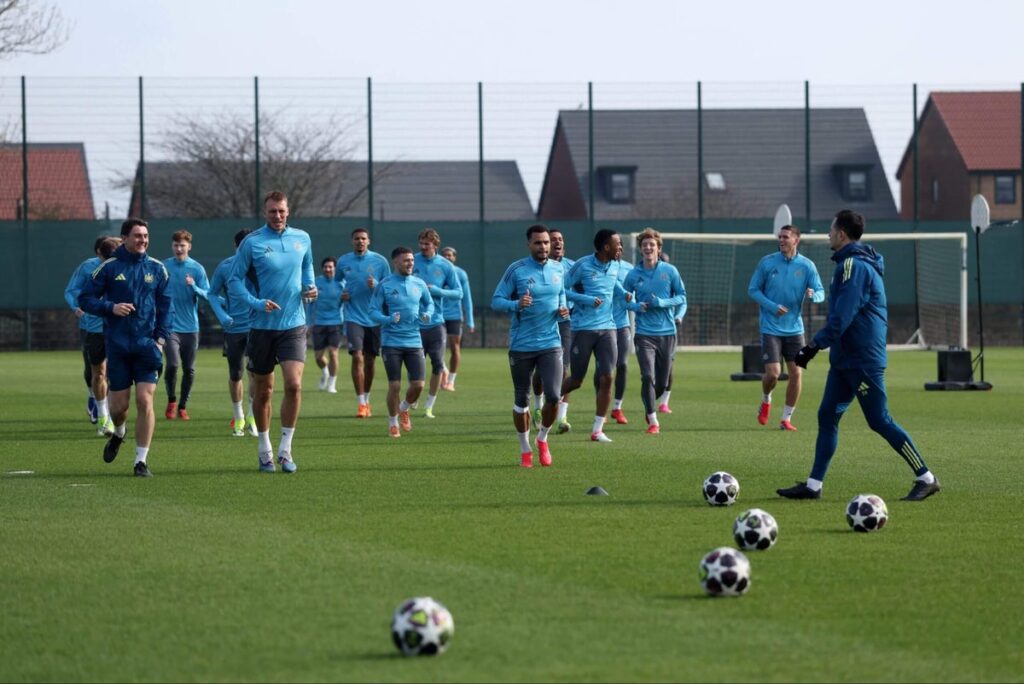

Four and a half years after the takeover, Newcastle United finally have the training-ground sponsor many fans were clamouring for.
Whether it should have taken that long is up for debate, but the news provides affirmation of the change in commercial direction under David Hopkinson, the chief executive who joined in September.
The Canadian promised to significantly bolster Newcastle’s revenue streams with fresh and bespoke deals. It has taken seven months — the 54-year-old did arrive in-season, and most deals tend to begin at the start of a campaign — but Hopkinson can now point to tangible evidence of the deals he envisages Newcastle striking moving forwards.
As The Athletic exclusively revealed, KNOX Hydration has taken up a three-year naming-rights deal to become the first-ever sponsor of Newcastle’s Darsley Park training ground, and will also feature on the training-kit sleeve, from 2026-27. The deal is worth around £6million ($8m) a season — or £18m over the three years.
Newcastle are already in discussions with other potential sponsors — their kit deal with Sela expires this summer, but they are also exploring further fresh opportunities, including a prospective front-of-training-wear tie-up — and Hopkinson hopes this acts as a signal.
“This is a message to the marketplace,” Hopkinson says. “It confirms companies are energised by our status as a challenger brand and want to come on that journey with us, and shows the types of people we want to partner with.”
Critically, KNOX is not affiliated with Saudi Arabia’s Public Investment Fund (PIF), Newcastle’s 85 per cent majority owners. It is a sports-drinks company founded in South Africa which says it offers “clean, caffeine-free hydration”.
In 2024-25, 34.4 per cent of Newcastle’s commercial income (£34.4m of £120.2m) came from deals with PIF-related firms, which the Premier League defines as “associated-party transactions” (APTs) and require fair-market value (FMV) testing. Newcastle’s current £25m-a-year front-of-shirt sponsor Sela is a PIF firm.
While the Premier League has theoretically relaxed restrictions following Manchester City’s legal challenges, UEFA rules over APTs remain more prohibitive. Although Newcastle will continue to agree deals with PIF-related companies, Hopkinson was keen to diversify.
The CEO is adamant that the only way Newcastle have any chance of realising his hyper-ambitious ‘Vision 2030’ — of challenging for the biggest honours by the end of the decade — is by greatly increasing their revenue. The most straightforward way, aside from reaching the Champions League every season, is by increasing commercial income, given it is still half the average achieved by the so-called ‘Big Six’ in 2024-25 (£288.2m).
Newcastle vs ‘Big Six’ revenue, 2023-24
| Club | Turnover | Matchday income | Commercial Income |
|---|---|---|---|
|
Manchester City |
£716m |
£75m |
£340m |
|
Manchester United |
£666m |
£160m |
£333m |
|
Arsenal |
£691m |
£154m |
£263m |
|
Liverpool |
£702m |
£116m |
£323m |
|
Tottenham Hotspur |
£566m (est.) |
£126m |
£245m (2023-24) |
|
Chelsea |
£492m (est.) |
£80m (2023-24) |
£225m (2023-24) |
|
Newcastle United |
£335m |
£52m |
£120m |
|
Big Six’ average |
£639m |
£119m |
£288m |
PIF sponsorship deals cannot close that gap entirely. Creative sponsorship opportunities need to be identified; the training ground is the first, but others will follow — perhaps including, although nobody has said this on or off the record, a St James’ Park naming-rights deal.
“We need to take advantage of every opportunity to drive revenues,” says Hopkinson. “We live in an SCR (the Premier League’s squad-cost rules, which are replacing profit and sustainability rules from 2026-27) world and greater revenues mean greater opportunities for the squad. From the business side, that’s our top mission. This KNOX revenue is meaningful.”
What does that actually mean? Where does it rank, relative to other training-ground sponsorship deals?
“This would be world-leading in its activation and integration into the club,” Hopkinson says, while not putting a figure on it (and Newcastle have not publicly confirmed its value). “I’ve had the privilege of working at Real Madrid’s training ground, which is extraordinary. AXA’s relationship with Liverpool is terrific.
“When we looked at, ‘What does world leading look like?’, we looked at both. From an ambition and partnership perspective, we believe KNOX is going to fit nicely into that elite level.”
The failure to land a training-ground sponsor sooner has exasperated many fans, yet few top clubs actually have one. Liverpool have AXA, Arsenal’s partner is Sobha Realty and Manchester City’s is part of the Etihad Campus, but most clubs, especially those without relatively new sites, do not have a title sponsor.
For Newcastle to secure £6m a year for their present training ground — which, although currently being renovated as part of an ongoing £30m expansion, the club have publicly stated they will move away from in search of a “10-out-of-10” facility — feels unexpected. Once they add a front-of-training-kit sponsor, which insiders feel could be even more lucrative, Newcastle believe the cumulative value will rank alongside the clubs mentioned above.

Hopkinson praised the training ground (Serena Taylor/Newcastle United via Getty Images)
“This training ground is very good,” says Hopkinson. “The facilities are excellent, and we’ve got world-class athletes and staff working here. It’s a vibrant, elite-performance centre.
“We’re continuing to invest every day to make it better, and our ambition ultimately is to build an even greater training ground, but KNOX agrees that we’ve got great things going on here today and greater things to look forward to.”
Despite identifying land for a world-class training centre in Woolsington, near Newcastle International Airport, such a substantial infrastructure project is multiple years away. Naming rights for that would be substantially more rewarding.
More as a happy coincidence rather than as a conscious discussion point during negotiations, the hope is Newcastle may be in a position to move into their new site by the end of the three-year deal with KNOX, or at least soon afterwards. So, did the company not hold reservations about sponsoring the Benton training ground, which Newcastle openly admit they are looking to move out of?
“We want progress,” says John Schaefer, KNOX’s CEO, who was at St James’ for Newcastle’s derby defeat to Sunderland. “That’s actually attractive to us. We don’t want a partner who is stagnant and happy with the status quo. We want to be better. We’re even more excited that they want to do another training ground. We’d love to be a part of that.”
In the here and now, both parties insist they are “ideal partners”, with Hopkinson referring to Newcastle and KNOX as “challenger brands”.
“We have a high conviction we can win together,” Hopkinson says. “That’s the journey we want to go on together.”
KNOX were keen to partner with a Premier League club, given its global appeal and because the firm launches in the UK this summer.
Schaefer cites four reasons behind choosing Newcastle — “the fans, No 1”, the club’s history, their desire to “modernise in search of elite performance”, and the owners’ “vision”.
“You feel all this energy around the place of, ‘Hey, we’re going to be No 1 within five years, not within 20 years’,” Schaefer says. “That’s really exciting and feels like a natural fit for us.
“Our product, we genuinely believe, is the best thing a multi-million-dollar athlete can put into their fine-tuned body. I could put our name on a stadium, but what has that got to do with us? A training ground makes perfect sense.
“We both want to become the best of the best. We’re on a parallel path of growing together with Newcastle, and I see us both being No 1.”
Many onlookers will scoff at that suggestion, just as they did when Hopkinson publicly declared Newcastle wanted to be among the world’s best clubs by 2030.
This week’s financial results, despite encouragingly showing record revenue and commercial income in a non-Champions League campaign, also underlined the chasm which still exists to the established elite.
Newcastle are 12th in the Premier League, and European football is far from guaranteed for next season, so is Hopkinson sticking by that timeframe?
“Our long-term ambition remains undiminished,” says Hopkinson. “We’ve talked openly about consistently and credibly competing by 2030. Moments like this (deal) substantiate that ambition.
“It’s not lost on me that we had miserable recent results, but I’ve come in every morning since with the same enthusiasm as if we’d won 5-0 against Sunderland. What we’re talking about here are our strategic goals — and they’re unchanged.”