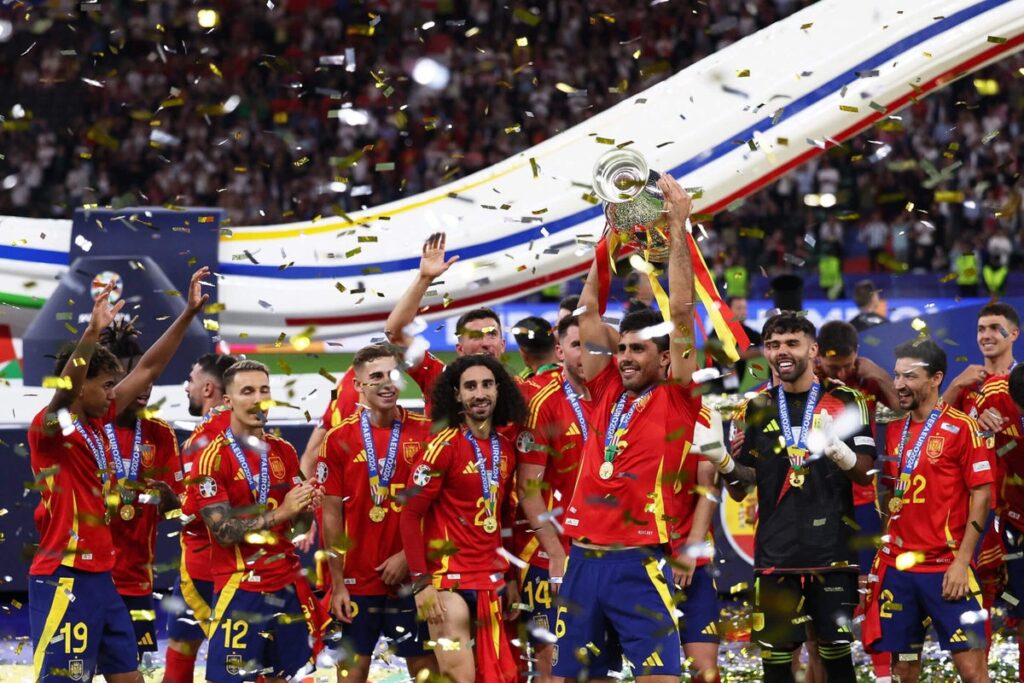

UEFA is planning to freeze most of the ticket prices for the 2028 men’s European Championship, in stark contrast to FIFA’s policy for this summer’s World Cup.
FIFA is selling the 6.7 million tickets it has available for the 104-game tournament in four price categories, with the cheapest category-four ticket starting at $60 (£45) for a group-stage game, but the most expensive – a category-one ticket for a high-profile group-stage match — costing as much as $2,700 (£2,050).
The numbers rise dramatically as the tournament progresses, with the cheapest face-value ticket for the final at the MetLife Stadium in New Jersey on July 19 costing more than $2,000 (£1,500) and the most expensive at almost $8,000 (£6,000).
These eye-watering prices, plus the small number of tickets available in the cheapest category, FIFA’s decision to use a dynamic pricing model and the commission fees it is charging on the official resale site, have all been heavily criticised by fans’ groups around the world.
Last week, Football Supporters Europe teamed up with a consumer rights group to make a formal complaint against FIFA at the European Commission.
UEFA, on the other hand, is planning to freeze most of its prices for the Euro 2028 in England, Scotland, Wales and Ireland at the same rates it charged for Euro 2024. This means its cheapest category, what it calls its “Fans First” ticket, will be approximately £26 ($34), with the next highest ticket, category three, in the region of £52 ($69). The prices will broadly correspond with the €30/€60 figures used in Germany.
At the tournament’s official launch last November, English Football Association chief executive Mark Bullingham said “approximately half” of the three million tickets available will be in these two categories, while a UEFA press release in December put the figure at “more than 40 per cent”.
This means there will be at least 1.2 million tickets available at Euro 2028 at a similar price, or cheaper, to the tiny number of tickets FIFA made available in category four at this summer’s tournament — none of which will be available when the fourth and final sales window opens this week.
In fact, a fan hoping to go to Euro 2028 will have a chance of buying tickets for five group-stage games for the same price as the average cost of a parking space at a stadium at this summer’s World Cup, which is currently $175 (£132).
The final price list for Euro 2028 is not expected to be confirmed until 2027 but UEFA has indicated that it will raise prices for the poshest seats and hospitality packages. One idea is to create a new “1+” category for high rollers, an approach FIFA appears to have taken for all categories.
Backlash against FIFA’s prices
“FIFA has embraced a familiar opportunity: permission to price-gouge,” said Lindsay Owens, executive director at Washington D.C.-based think tank Groundwork Collaborative. Ticket prices for soccer’s premier tournament have in some cases topped $80,000.
“FIFA insists its hands are tied, blaming domestic market conditions, but as the arbiter of its own primary and secondary ticketing marketplace, FIFA could make tickets affordable if it wanted to.
“It could reserve seats for loyal supporters. In fact, it has done both before. Instead, FIFA has chosen to cash in on the market failures endemic to American ticketing, weaponizing scarcity and monopoly control to squeeze every penny from fans chasing a once-in-a-lifetime experience.
“The irony is hard to miss: in chasing maximum revenue, FIFA risks shrinking the very audience that made the World Cup seemingly priceless.”
Ahmed Nilmale, a former executive at global entertainment company Live Nation and chief executive of KYD Labs, a ticketing provider in New York, agrees.
“This is what happens when one entity controls both supply and distribution,” said Nilmale. “Without competition, there is nothing to keep pricing or fees in check, and fans are left with no real alternatives.
“FIFA directly owns, controls, and manages all ticketing for the World Cup, one of the most-watched sporting events on the planet, expected to draw as many as 5.5 million fans. With demand all but guaranteed, the absence of competition becomes the story.
“The European Commission has a rare opportunity to intervene in a way that actually changes market structure. Introducing multiple ticketing providers would force real competition into the system and create meaningful accountability for fans.”
For its part, FIFA says it received more than 500 million ticket requests during the last sales window, resulting in more than one million sales. It also repeatedly points out that it is a non-profit organisation which “reinvests” the money it makes at major tournaments in football development programmes around the world.