
ATLANTA — “Shot! Shot! Shot-shot-shot-shot!”
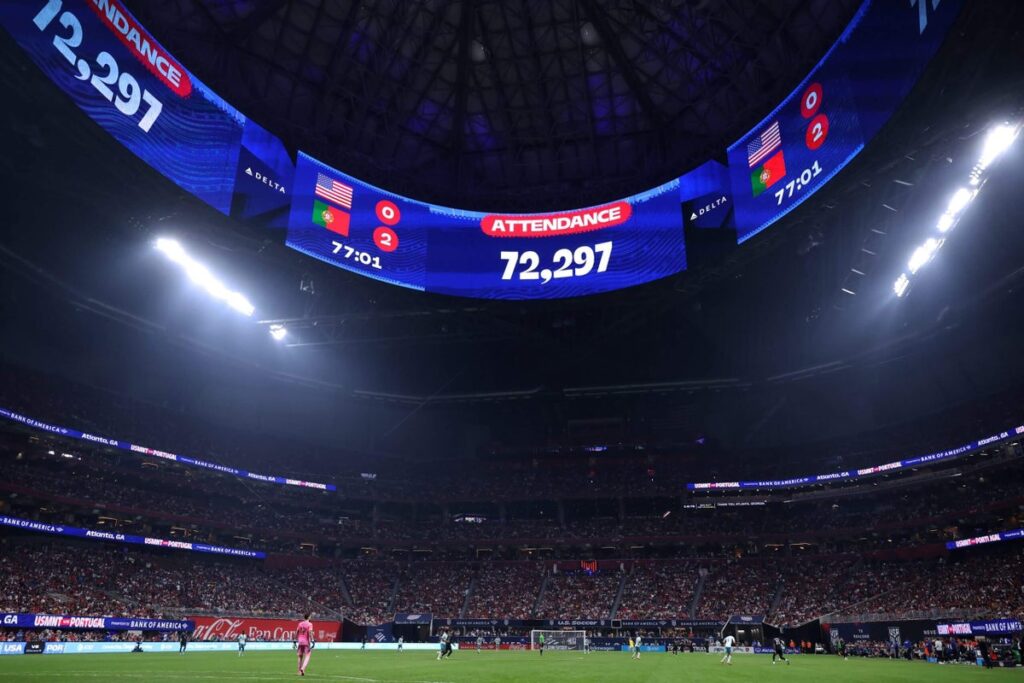
LMFAO’s club anthem blasted through the Mercedes-Benz Stadium loudspeakers. The stadium DJ, wearing the latest U.S. national team home jersey, as well as the public address announcer, encouraged more than 70,000 people in attendance to get ready for the friendly between the U.S. and Portugal in Atlanta.
Fireworks were set off at midfield and flames shot out from behind the goals. The DJ stand at the stadium didn’t look like a big-budget setup, but the single performer was one of the main protagonists on the night that epitomized an international soccer match in the U.S. During one of the two FIFA-mandated hydration breaks, the stadium atmosphere was akin to a timeout or stoppage of play of an NBA game.
Men, women and children reacted excitedly when they were displayed on the stadium’s gigantic, 360-degree halo board. The DJ played the hip-hop track B.O.B (Bombs over Baghdad) by Atlanta rap legends Outkast. These musical interventions were a common theme on the night. There was a halftime show featuring dancers, more fireworks, and a medley of Atlanta hip hop classics.
The crowd loved it.
Prior to the second-half kick-off, the PA announcer urged the fans, hundreds of whom were strolling about the massive stadium either shopping, drinking or grabbing a quick meal.
“We’ve got 45 minutes left! Time to get back to your seats and get loud!” The announcer’s plea was followed by a medley of electronic music that was so loud that the U.S. head coach Mauricio Pochettino had trouble hearing TNT’s sideline reporter during a brief interview.
When asked after the game about the stadium backdrop and whether it felt like a legitimate home crowd, U.S. defender Auston Trusty offered glowing reviews. “Atlanta’s a great city for us to play in,” he said. “To play here and play in this atmosphere, it’s really, really good.”
U.S. midfielder Weston McKennie had similar reviews.
“Today was a great show out (by the fans),” he said. “Obviously, our team colors are also red. So I don’t know if it was Portugal fans or our fans, but it was definitely a great show out and definitely something that gets us excited to be able to play a World Cup on home soil.”
The response from Trusty and McKennie, and the raucous music inside an NFL arena, are all quintessentially American. Yet there’s something else that’s quite American at a soccer game in the States. Indifference.

Mexico’s friendly with Portugal last weekend saw a feast of color. (Rodrigo Oropeza / Getty Images)
With the score 2-0 in Portugal’s favor, and with the Europeans casually spreading the ball around a beleaguered U.S. side, a small section of American supporters attempted to start the “wave.” It was near the 70th-minute mark and a handful of people stood up and lifted their arms in unison.
Others did so while staying seated. It was a failed attempt to revive a crowd that had very little to cheer about. But what is more telling about that moment was the timing of the gesture.
Instead of jeering the Americans during another disappointing performance, the pro-U.S. crowd did nothing to let the players know that their patience with the team was running out. Three days prior in Mexico City, Portugal faced co-hosts Mexico at the newly renovated Estadio Azteca, now rebranded as the Estadio Banorte. Nearly 90,000 people attended the match.
It was hostile, at times even for the home team. When Portugal were in possession, or before a corner kick in its favor, the home crowd whistled so loudly that the television announcers had to raise their voices for the broadcast. The atmosphere was tense. It felt like a hornet’s nest. Mexico’s fans are so critical of their national team, and so thoroughly disheartened by El Tri’s years-long stretch of subpar performances, that they are easily triggered when the team shows even a hint of the same old frailties.
The Azteca is a hallowed ground in Mexico and the players embrace that reality. Mexico has lost just twice in official matches since the stadium opened in 1966. On Saturday, Mexico drew 0-0 in a hard-fought and physical game against a much better Portuguese team. After the game, Mexico defensive midfielder Erik Lira made it clear that the venue brings an advantage all of its own.
“Our fans pay to watch a show,” he said. “Because in the end, this is a spectacle. We can only control what we do on the pitch. It doesn’t matter what national team comes to our stadium, they’re not coming here to win. And if they do, they’re going to leave here dead.”
Perhaps Lira misspoke. But the message, in a sporting context, was clear. The Azteca will not be disrespected. And the Mexico national team, despite its limitations, is going to battle to a metaphorical death, or at least play for pride until the final whistle. The differing atmospheres in Atlanta and Mexico City tell a story of two very different soccer cultures. It’s a subjective exercise to say that one is better than the other.
Mexico played admirably against Portugal but the home fans weren’t impressed. Mexico was mocked by the partisan crowd at the final whistle. When Portugal had a spell of possession in the second half, the crowd chanted “Olé!,” ridiculing the players. The homophobic chant that has marred Mexican football for over a decade was also heard on the night.
The U.S. national team doesn’t have a traditional home ground. The team travels the country and plays in different states and regions depending on the opponent and the stakes of the game. The U.S. men’s national team is accustomed to playing on home soil and feeling like the crowd is split nearly 50/50, depending on the opponent, which is a given considering the diversity of the U.S. population.
Now Atlanta is the home of the U.S. soccer federation’s headquarters. And Mercedes-Benz Stadium is one of the most impressive arenas in the world. But the question is whether this modern marvel of a stadium, or any arena in the country, can become a fortress for the Americans. The current team under Pochettino needs a psychological boost that goes beyond tactics and motivational team talks. Trusty said that the Mercedes-Benz Stadium support felt like a home crowd, even though a sizable contingent of Portuguese fans (or Cristiano Ronaldo fans, though Ronaldo’s injury kept him out) were noticeably louder.
In Los Angeles and Seattle, where the U.S. will play its three World Cup group-stage matches this summer, the Americans should benefit from home-field advantage. Against Paraguay, Australia and Turkey, it is expected that Sofi Stadium in L.A. and Lumen Field in Seattle will be packed with American supporters. It should feel like home.
But will it be enough to shield the U.S. team from its flaws?
“We won’t say we expect it,” McKennie said, “but we definitely hope that the fans and everyone will come out and be behind us and support us.”