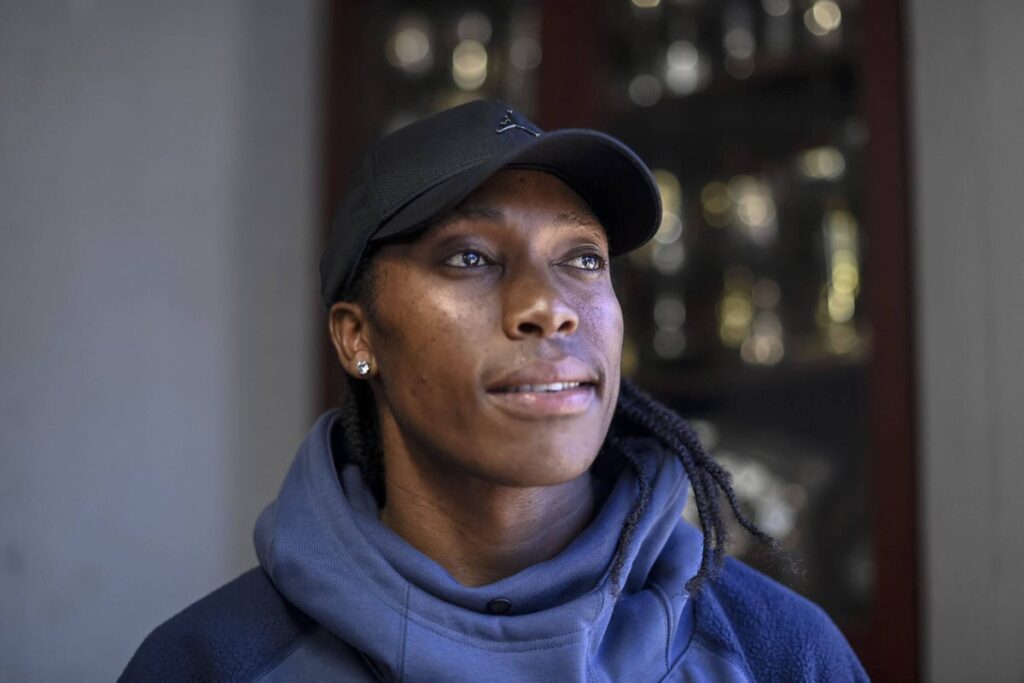

Two-time Olympian Caster Semenya on Sunday criticized the International Olympic Committee’s recent decision to require gene testing for women and ban transgender athletes — policies the South African track star spent nearly a decade challenging in court.
Semenya pointed her critiques at International Olympic Committee President Kirsty Coventry of Zimbabwe, saying Coventry should be more understanding of the barriers African women in sports face.
“Personally, for her as a leader, she’s an African, I’m sure she understands how, you know, we as Africans, we are coming from, as a global South, you know, you cannot control genetics,” Semenya said Sunday at a news conference after a women’s race in Cape Town.
The comments came three days after the IOC released an updated policy restricting transgender women from competing alongside cisgender opponents. That eligibility policy will apply to the 2028 Los Angeles Olympics, and the IOC said Thursday that the rule “protects fairness, safety and integrity in the female category.”
South African Caster Semenya, a two-time Olympic 800 metres champion, said on Sunday that the IOC’s reinstatement of gender verification tests for the 2028 Los Angeles Games was “a disrespect for women”.
The International Olympic Committee (IOC) reinstated genetic testing to… pic.twitter.com/KJ1fwVpztV
— Sportstar (@sportstarweb) March 29, 2026
Semenya, who does not consider herself transgender, was labeled a woman at birth, but her body naturally produces abnormally high levels of testosterone due to a condition called 5-alpha reductase deficiency (5aR2D). Those with conditions like Semenya’s are described as having a difference in sex development, known as a DSD, a medical categorization distinct from a person’s gender identity.
Alongside the ban on trans competitors, the IOC’s policy also restricts the participation of many other athletes with a DSD and atypical biology, which Semenya described as a departure from science. She further framed the restrictions as hypocritical, given the IOC’s public touting of inclusion initiatives.
“Obviously, if you say the science — because we talk about science here — if the science is clear, show us who decided,” said Semenya, a former sports science student. “… Here we’re talking about, you know, human rights. We’re talking about diversity. And if you are an organization like the IOC, (and) you’re talking about diversity, act like one.”
The policy the IOC released Thursday builds upon rules from the 2024 Paris Olympics, when the committee banned women who have gone through “male puberty” from competing in track and field, swimming and cycling.
“The IOC recognises that XY (chromosome) athletes who identify as women and who want the opportunity to compete at IOC Events according to their legal sex or gender identity may disagree with this Policy,” the IOC memo said. “However, after a thorough scientific review and consultations with constituents of the Olympic Movement, the IOC determined that a Sex-based eligibility rule is necessary and adequate to the attainment of the IOC’s goals for competition at IOC Events.”
Despite not being trans, Semenya’s case has been a focal point for global debates for years over who should get to compete in women’s sports.
The track star has been a controversial figure since 2009, when she was first subjected to pre-race sex confirmation tests. International attention intensified after Semenya won back-to-back Olympic gold medals in the 800-meter race at the 2012 London Games and 2016 Rio Games. Several of her opponents described the race as unfair, while Semenya’s supporters rallied around her, calling the criticism a discriminatory attempt to undermine African athletes.
Since 2019, Semenya has been banned from major international races between 400 and 1,500 meters for refusing to take hormone-suppressing medication. She referenced requirements like that as causing “bodily harm” in her remarks this weekend.
“For you as a woman, why will you be tested to prove that you fit? It’s like now we need to prove that we are worthy as women to take part in sports. That is disrespect for women,” Semenya said at the news conference. “ … Why will you allow women to take part in sports if you’re going to question them?”
Semenya spent seven years locked in court battles over various sex eligibility policies, and won a European Court of Human Rights ruling last year that said her rights were violated during her most recent appeal of World Athletics restrictions. It did not, however, overturn any of the restrictions Semenya challenged.
“I’ve been broken before, but I had to find a way to gather myself, pick up the pieces and go out there fighting for all women,” she said in a Sky Sports interview released Saturday, during which she called the IOC policy “nonsense.”
“We are fighting for women’s dignity,” Semenya added.
She has since retired from high-level competition and said that while she will continue fighting on behalf of DSD athletes, she will not pursue any more legal battles against her sport’s governing bodies.