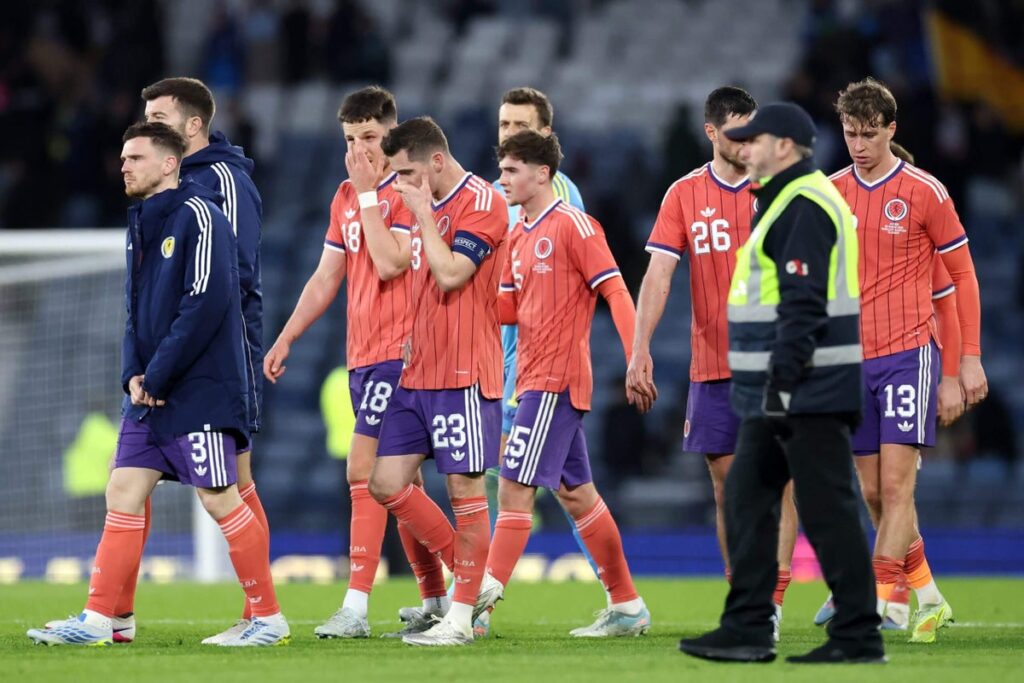

The sarcastic cheers urging Kenny McLean to shoot anytime he was in the vicinity of the halfway line were a reminder of that euphoric night at Hampden Park 130 days ago, when Scotland condensed three decades’ worth of wonder goals into one evening.
It was the only part of the 1-0 defeat to Japan that stopped the 45,000-strong home crowd questioning whether that night in November had been a fever dream.
They had come to pay tribute to Steve Clarke’s men, their first reunion since the famous 4-2 victory over Denmark, which sealed their place at the World Cup for the first time in 28 years.
Kids queued for photos in front of the new Scott McTominay mural depicting his overhead kick, painted onto the side of the tenements that watch over Lesser Hampden. Thousands sported the popular new purple salmon away kit, a bold look to mirror a team with a bold list of achievements.
Yet, on an evening designed for the players to feel the love and build momentum with the wind at their back, Scotland left the pitch to a smattering of boos.
“(It) disappointed me, to be honest. It is just the modern way, it seems. If you lose a game, you get booed. You just have to deal with it,” said Clarke.
It was an over-reaction to a friendly, particularly when Scotland are for some reason hopeless at them, failing to win any of their last 11 home friendlies since 2016. But while frustration at not maintaining the energy and momentum of four months ago was understandable, the bigger concern for fans is that Scotland are here once again, facing into a major tournament with the same questions they had entering EURO 2020 and EURO 2024.
No pace, no wingers and no main character centre forward. A perennial creativity crisis. Try building an international team without those tools. Saturday’s abject performance against Japan becomes a lesson in realism.
Scotland started with Charlton Athletic target man Lyndon Dykes, flanked by Middlesbrough’s Tommy Conway on the left wing and John McGinn on the right. By trade, Conway is a striker and McGinn a central midfielder. They ended with Ipswich Town’s George Hirst — who has started just two of the last 10 Championship matches — leading the line, with Bournemouth’s deep-lying midfielder Ryan Christie on one side and 19-year-old Findlay Curtis, on loan at Kilmarnock from Rangers, on the other.

An isolated Lyndon Dykes struggled to find opportunities against Japan (Andy Buchanan/ AFP via Getty Images)
In contrast, Japan’s second-string that started consisted of the third-top goalscorer in Belgium, Sint-Truiden’s Keisuke Goto, supported by Freiburg’s Yuito Suzuki and NEC Nijmegen’s Kodai Sano. In the second half, they brought on Brighton’s Kaoru Mitoma, Eintracht Frankfurt’s Ritsu Doan, Reims’ Keito Nakamura, Feyenoord’s Ayase Ueda and Wolfsburg’s Kento Shiogai. Mostly top-five league players and often the outstanding player from their club side. That is without mentioning the match-winner, Genk’s Junya Ito.
It underlined why Japan are 18th and Scotland are 40th in the FIFA world rankings. The talent production is poles apart, and the reason Scotland are still facing the same problems they did five years ago.
As much as fans bemoan a lack of change in the squad, Clarke is not leaving world beaters at home. Che Adams will likely start up front and Hearts captain Lawrence Shankland offers a more all-round skill set up front, but there is little to nothing on the wings. Had Newcastle’s Harvey Barnes fancied playing at a World Cup rather than being England’s 37th man, he would have had a seat on the plane.
That is how chronic the lack of options is — and why Scotland badly need Ben Gannon-Doak back playing so he is fit for June. The Bournemouth winger has been out since tearing his hamstring for Scotland in the game against Denmark four months ago, and his acceleration and directness were sorely absent against Japan. Without him, Scotland ask few questions.
Clarke played with Conway and McGinn coming in from wide positions, which, in theory, should have allowed Andy Robertson and Nathan Patterson to provide width from the full-back positions. But the former’s delivery was off and the latter never really got into those areas.
Conway rarely got into the game in an attacking sense but Clarke praised his efforts as the latest player to be trialled as a makeshift wide player.
“He’s had a few chances before but never as a starter and never from that position. We don’t have a load of wide players, so it was also nice to get young Findlay on the pitch. It was a difficult moment to come into the game. But Tommy was decent.
“We maybe didn’t create enough in the final third of the pitch and that’s something we’ll look at. But that’s something we’ve spoken about often. We keep working on that and keep trying to get better at that.”

Tommy Conway worked hard but struggled to make an attacking impact (Ian MacNicol/Getty Images)
The only real chance Scotland created was McTominay’s first-half volley when he ran onto McGinn’s cross, a reminder that their two main goalscoring threats remain midfielders. Who is there to create for them, though? As that one chance showed, they often have to feed off their own scraps.
Scotland missed the influence of Billy Gilmour in midfield to connect play as Japan dominated possession and Scotland were forced into playing long to an isolated Dykes too often. It is a similar pattern as has emerged at the last two tournaments, which is why Tuesday’s friendly against Ivory Coast has to show evidence of a more sustainable idea of building meaningful attacks.
Before Euro 2020, Scotland played the Netherlands (a 2-2 draw) and Luxembourg (a narrow 1-0 victory over 10 men). Prior to Euro 2024, Scotland played the Netherlands and Northern Ireland before facing Gibraltar and Finland in the warm-ups. They won just one of the four.
The fear is that Scotland lose confidence before the World Cup, but Clarke believes it is the right way to treat friendlies.
“I sometimes think my players look at me and think ‘C’mon gaffer, what are you doing’, but I always try to pick difficult friendlies,” said Clarke.
“If the performance is good, and you can take things from it, then you can carry that forward. This is where you have to be at, lads. This is the level you have to reach, and if you want to get the points to get out the group stage, then you have to play to that standard.
“But there was enough in it to feel positive about what we’re trying to do.”