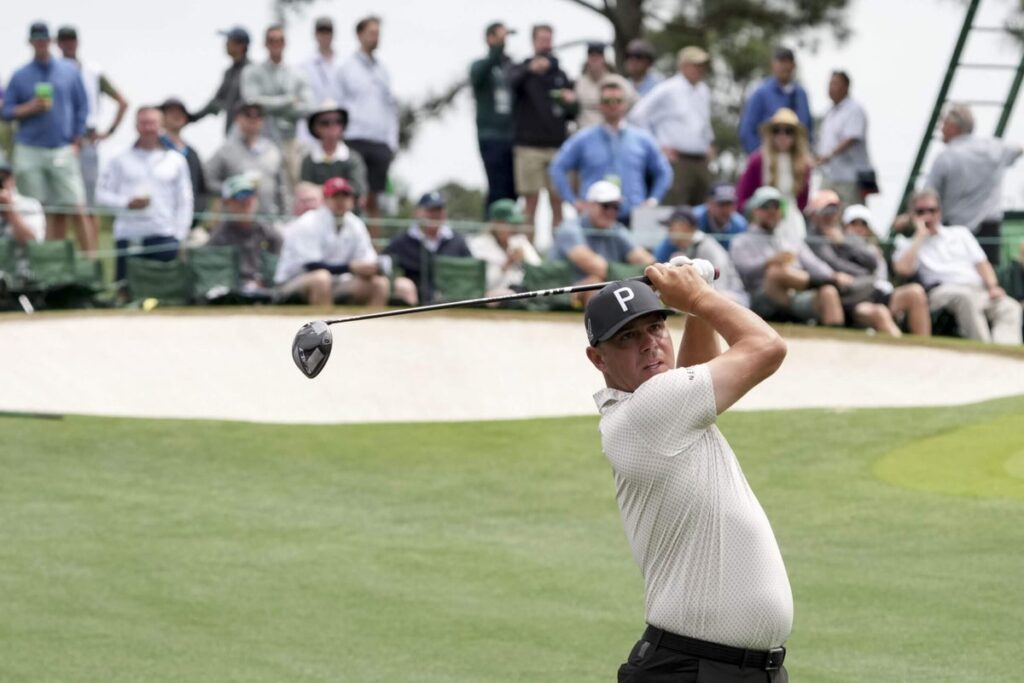

Gary Woodland is excited to return to the Masters after missing last year’s tournament. Still, he’s focused on his health and safety first as he continues to struggle with post-traumatic stress disorder.
“I know what I’m battling every day. People ask me, “How was the win?’” Woodland said Tuesday during a Masters news conference, referring to his Texas Children’s Open win on March 29. “The one thing I know is having this brain tumor and having PTSD, it doesn’t matter if I win or lose. It doesn’t care. I had a tough time last week battling this stuff. A lot of stimulation comes with winning, stuff I hadn’t seen in a long time.
“It’s a big week for me this week. The fans are very close on the tee boxes. There’s a lot going on. There’s probably not a safer golf tournament in the world, so I’m happy for that, but it’s still a battle in my head if I’m safe or not. That’s a tough pill to swallow.”
Last month, Woodland revealed he was diagnosed with PTSD during the recovery process from his brain surgery in September 2023, during which a tumor was removed that was causing him extreme anxiety and panic attacks.
In the months before the surgery, Woodland did not understand what was wrong with him — he’d wake up in the middle of the night, clutching his bed, thinking he was falling to his death. Furthermore, the symptoms came on suddenly, without warning. “I thought everything was going to kill me,” Woodland said at the time.
Doctors eventually discovered that a noncancerous lesion was pressing against the part of the brain that dictates fear. Woodland’s episodes were diagnosed as partial seizures. While the craniotomy in 2023 was successful, the tumor had to be removed through a “baseball-sized hole” in his skull.
When he miraculously returned to golf four months later, Woodland’s body was healthy, but he continued to experience mental symptoms such as hypervigilance and panic.
Woodland revealed in a post-round news conference at the Texas Children’s Open in Houston that he “got extremely hypervigilant” when a few individuals got too close to him inside the ropes on the back nine in Friday’s round. Woodland leaned on his private security but could not calm down for the remainder of the round.
“I got into scoring, I bawled my eyes out, I reset and was able to come back out and take care of stuff after,” he said at the time.
Woodland successfully took care of it by winning, marking his first PGA Tour victory since the 2019 U.S. Open. He shot 21 under par, winning by five shots over Nicolai Højgaard.
The win also qualified Woodland to return to the Masters. He failed to earn an invitation last year, missing the first major championship of the season for the first time since 2016.
“I’m emotional from the standpoint I know how close I probably was to never being back here, and I’m very proud of myself for earning my way back,” Woodland said Tuesday.
He elaborated on his struggles in Houston, explaining how he relied on the PGA Tour’s security team to help him get through the tournament.
“I had a big battle Friday of Houston. I got hypervigilant on the ninth hole, and I battled the last 10 holes thinking people were trying to kill me. I have security with me. The tour’s been amazing.
“But I talked to tour security that night, and I told them what I was going through, and every time I looked up on the weekend, my security team was behind me. Any time I got startled on the weekend, I turned around. Last year, I didn’t talk to tour security. I fought this on my own. It was awful. Turning around and knowing that I’m safe, having somebody there with me, it’s the only reason why I won like two weeks ago.”
Woodland encouraged people struggling with PTSD to talk to someone about it, saying he feels “stronger” after publicly revealing the news and working with security teams.
He said the PGA Tour reached out to Augusta National’s security team on his behalf, and he met them after arriving in Augusta.
“The main deal is they were showing me where security is. The whole deal for me is it’s visual, right? If I can see somebody, then I can remind myself that I’m safe constantly.
“So I have a good idea now where security is on every hole. The big deal for me — my caddie knows too — so he can constantly remind me. Like I said, I don’t have control when this thing hits me, and it’s tough. It can be a fan. It can be a walking score. It can be a camera guy running by me, just any startlement from behind me can trigger this pretty quickly. Knowing where the security is is a constant reminder that I’m safe.”