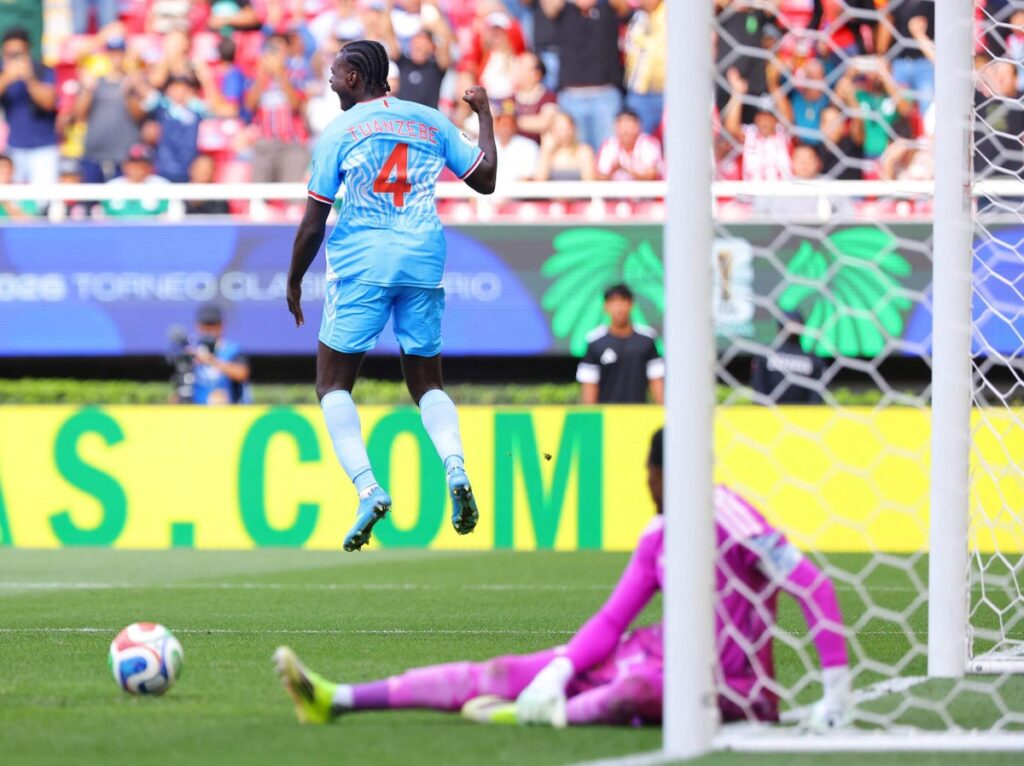

DR Congo became the 47th team to qualify for this summer’s World Cup, thanks to a battling 1-0 extra-time win over Jamaica in the sunshine of Guadalajara. It is the first time they have reached the finals since 1974, when they were known as Zaire.
In a game low on quality and chances Axel Tuanzebe scored from a corner to take DR Congo to the finals, where they take their place in Group K against Portugal, Colombia and Uzbekistan.
In regular time, both sides played cautiously, taking few risks. DR Congo made a strong start — Cedric Bakambu having a goal ruled out for offside — but couldn’t take advantage of their superiority and Jamaica grew into a contest that was low on chances.
In the second half the Jamaicans offered more threat, without necessarily creating clear opportunities, with Kasey Palmer and Leon Bailey impressing. However, with the clock ticking towards extra time, Bakambu again had the ball in the net — only for it again to be correctly flagged for offside in the build up.

DR Congo’s Yoane Wissa battles with Jamaica’s Kasey Palmer (Ulises Ruiz/AFP via Getty Images)
With both sides flagging, it was perhaps not surprising that it was a set piece that made the difference. On 100 minutes, substitute Brian Cipenga whipped in a corner from the left that evaded both attacking and defensive players and bounced in off the onrushing Tuanzebe. There was a VAR review for handball, but the goal stood. It was not a spectacular way to win, but the DR Congo fans didn’t care.
For Jamaica, the wait for a first World Cup appearance since 1998 goes on.
Jack Lang dissects the key talking points.
What does this mean for DR Congo?
52 years. 52 years later, the Democratic Republic of Congo are going back to the World Cup. Forget the nerves, the missed chances, the lingering doubts; the job is done.
In 1974, then called Zaire, they became the first sub-Saharan African nation to reach the tournament. That their campaign yielded zero points and zero goals was painful but they could weigh it against two Africa Cup of Nations titles in quick succession. Good times seemed to be ahead.
They weren’t. DR Congo football sunk into the mire. The World Cup became both a dream and a distant, hazy memory. On a sun-soaked Guadalajara afternoon, they wrote a new script, Tuanzebe bundling home in extra time to bathe this team in new, warm light. All of the pain, all the scar tissue? Forgotten, irrelevant. A summer adventure beckons at last.
Inevitably, it was a psychodrama. How could it not be? DR Congo were the better team by a distance in the first half, wingers Nathanael Mbuku and Meschack Elia menacing the Jamaica defence, but there was no goal. When their opponents began to gain a foothold, the nerves began to jangle. One ludicrous long-range shot from Arthur Masuaku told its own story; the look he got from his head coach, Sebastien Desabre, reinforced it.

DR Congo head coach Sebastien Desabre had a nerve-jangling time on the sidelines (Simon Barber/Getty Images)
This side, though, is made of stern stuff. The Leopards steeled themselves, took a breath, went again, even as star man Noah Sadiki was forced off with an injury. Substitute Edo Kayembe pinged a shot just wide of one post then just wide of the other. Captain Bakambu tested Jamaica goalkeeper Andre Blake with an outlandish backheel.
They would need extra time to get over the line. An ugly goal, too, the moment in stark contrast to some of the zippy passing that preceded it. It didn’t matter. Tuanzebe celebrated like there was no tomorrow — like 1974 and 52 were just random numbers.
What happened to the referee?
No one likes getting injured in a big match. Sadiki, the Sunderland midfielder, befell that fate here. So, bless him, did referee Facundo Tello. We were well into the second half of extra time when the Argentine blew his whistle to pause play, confusing both sides.
What followed was the bizarre sight of the match official being tended to by players — half of whom, understandably, were keen to get the game restarted again as soon as possible. Eventually, after a lengthy stop and some carnival booing from the crowd, Tello made his way — slowly, painfully, his hand on his calf — to the sideline, to be replaced by his fourth official.

Referee Facundo Tello had to retire hurt (Ulises Ruiz/AFP via Getty Images)
He watched the remainder of the game, as well as DR Congo’s wild celebrations, from the touchline.
Was Palmer the best player on the pitch?
Against New Caledonia, Jamaica had exerted very little control in the middle of the park. Isaac Hayden huffed and puffed but received little support from Blackpool’s Karoy Anderson. The result? Constipated build-up play and a match that ended up being a lot closer than it might have been.
Here, it was a completely different story. That was almost entirely down to Palmer.
The 29-year-old has been a key player for Jamaica for some time but has been held back by injuries: he missed their last two regional qualifiers — no coincidence, perhaps, that their campaign petered out in his absence — and started the New Caledonia game on the bench, presumably as a precaution.

Kasey Palmer was outstanding for Jamaica (Agustin Cuevas/Getty Images)
Jamaica’s engine room took on an entire different dimension with him in it. Palmer passed crisply, slowed things down when circumstances demanded it. One wicked, disguised pass almost led to a goal for Bailey just before the hour. There were plenty of others.
More than anything else, Palmer generally just looked like the coolest man in the room. He did not deserve to be on the losing side.
What will DR Congo fans bring to the World Cup?
For the second time in six days, Guadalajara passed its World Cup test with flying colours. Access to the Estadio Akron was smooth, ticket lines organised, volunteers incredibly friendly and well informed. Fewer people were in the stands for this one than the New Caledonia vs Jamaica match — a 3pm kick-off on a weekday will do that — but the attendance was still more than respectable. There was a real buzz inside this lovely lava dome of a stadium before kick-off.
Part of that was down to curious Mexicans, who got behind both teams. But there was also a significant contingent from DR Congo, resplendent in light blue, their flags flittering in the afternoon breeze. There were thousands of them. By the time the game began, most were grouped together in the north west corner, a little slice of Kinshasa in North America.

DR Congo fans created a great atmosphere in Guadalajara (Ulises Ruiz/AFP via Getty Images)
Life in DR Congo can be tough. The county has been scarred by endless fighting involving rebel forces. They rank 178 of 188 countries in the International Monetary Fund’s GDP-per-capita table.
The players and head coach Desabre have spoken about giving those back home something to cheer about. They did that here. The World Cup will be all the brighter for the presence of these supporters this summer.