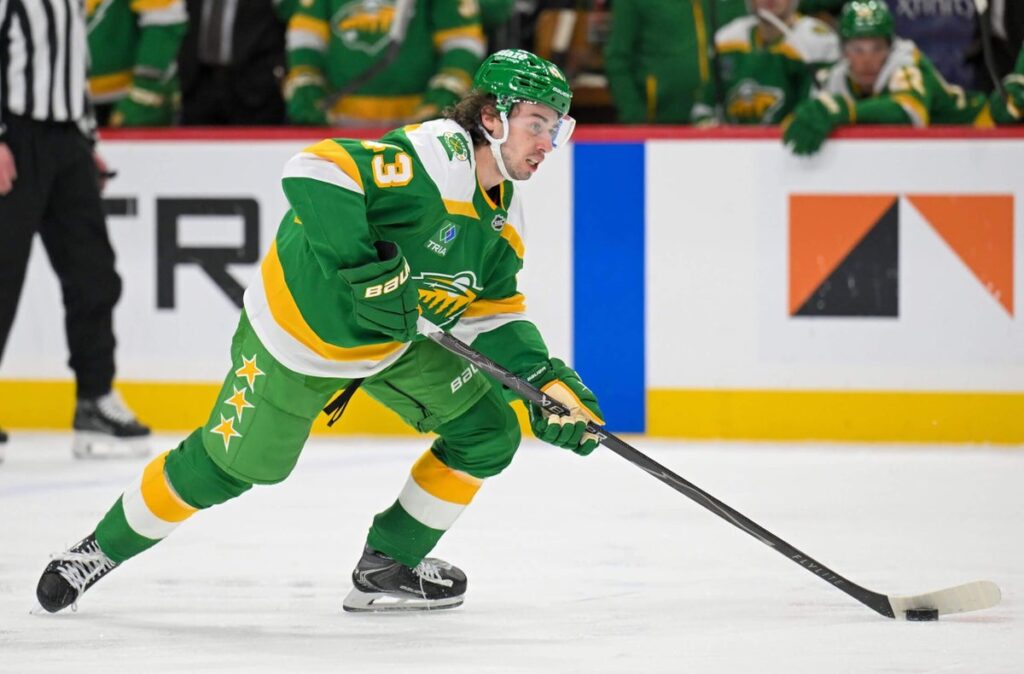

ST. PAUL, Minn. — There’s nothing Quinn Hughes can say or do that will heal the broken hearts of Vancouver Canucks fans.
That much was apparent in the lead-up to Hughes’ first game against his former team on Thursday night.
Hughes was asked pregame whether he was better prepared to account for his opponents’ tendencies, given his familiarity with the Canucks. Hughes honestly and innocuously answered “no.”
For one, Hughes explained, cheating defensively is how you get burned in the NHL. Secondly, with the intense rate of change in the Canucks locker room over the past 24 months, Hughes suggested he really wasn’t all that familiar with his opponent.
“Honestly, I don’t even really know a lot of their guys,” Hughes said. “Obviously, I played with some of the young guys there for three or four months, but a lot of the guys I was there with for the meat of my six years aren’t there.”
Canucks fans seized on the quote to suggest that Hughes’ leadership during his tenure as captain was wanting, but there was absolutely no animus present in Hughes’ commentary.
The astounding truth is that in Vancouver’s 5-2 loss to the Minnesota Wild on Thursday night, only three players who dressed for the Canucks in Game 7 of their second-round series against the Edmonton Oilers in May 2024 were even in the lineup (Filip Hronek, Elias Pettersson and Teddy Blueger).
Nils Höglander was in the lineup that warm May night in Vancouver, but was scratched on Thursday in Minnesota. Longtime Hughes teammate and friend Brock Boeser wasn’t in the lineup that fateful evening after he was diagnosed on the eve of the game with a dangerous blood-clotting issue that prevented him from safely competing.
Hughes was his usual self on Thursday, accessible and frank. He handled his media obligations — a full scrum following morning skate, an additional one-on-one with The Athletic, a warmup skate interview with the Wild broadcast and a postgame walk-off with the Canucks broadcast — like a pro.
On the ice, meanwhile, Hughes was effortlessly dynamic. He led all Wild skaters in ice time. He made logging nearly 25 minutes look easy.
In the third period, Hughes set a Wild franchise record for assists in a single season by a defenseman. Over the course of the contest, he drew a penalty, blocked a pair of shots, got suckered into a genuinely hilarious cross-checking penalty by Curtis Douglas and took four shots on goal — all of which registered as scoring chances, according to Natural Stat Trick.
In Hughes’ five-on-five minutes, meanwhile, the Wild outshot the Canucks 20-10, and outscored them 3-0.
Given all of the big moments that Hughes has lived through in recent months, this milestone game against his former club was a relatively minor blip. What matters for Hughes, and for the Wild now, is what lies ahead in the Stanley Cup playoffs.
It was fitting, given that the Canucks and Wild are so closely tied together now by the trade the two franchises executed in mid-December, that both teams clinched something of substance with Thursday night’s result.
The Wild clinched a playoff berth and are overwhelmingly likely to open the playoffs on the road against the Dallas Stars in two and a half weeks.
Vancouver, meanwhile, clinched the top odds for the NHL Draft Lottery in early May. It’s a critical, if ignominious, accomplishment for the rebuilding Canucks.
The Canucks will now have a 25 percent chance, the highest odds that any NHL team will have, to select No. 1, something that Vancouver has never done in franchise history.
The Canucks are now also guaranteed a top-three selection at the draft, which is of critical importance given the franchise’s desperate need for elite talent. And the Canucks will now select first in every subsequent round of the draft in which they own their own pick.
With Vancouver’s draft lottery odds and overall draft positioning now secured and maximized, we can turn our attention to one additional high-leverage thread impacting the value of its aggregate capital holdings at the 2026 NHL Draft.
Specifically, I’m referring to the 2026 first-round pick the Canucks acquired from the Wild in the Hughes blockbuster.
Once the playoff bracket is set, the first round draft order through pick No. 15 will be populated by the NHL’s non-playoff teams pending the outcome of the draft lottery. In a normal year, it would be set through pick No. 16, but the Ottawa Senators will pick 32nd as a result of a reduced punishment for the Evgenii Dadonov no-trade clause fiasco during the Pierre Dorion era, so this year will be a little bit different.
From there, picks Nos. 16 through 27 will be occupied by playoff teams eliminated in the first two rounds of the Stanley Cup playoffs.
The playoff round in which teams are eliminated has no bearing on the draft order in this range until the conference final. The draft order among the playoff teams eliminated before the conference final is set by inverse standings in the regular season, with the caveat that any division winner eliminated in the first two rounds is placed lower in the draft order than non-division winners, regardless of their comparative record.
Picks Nos. 28 and 29 are then awarded to the teams eliminated in the conference final, while picks Nos. 30 and 31 will be awarded to the Stanley Cup finalists. Then the Senators will pick 32nd, but are not permitted to trade the draft pick.
The rub here from a Vancouver perspective is that Minnesota currently holds the NHL’s seventh-best record. While the Wild won’t win the Central Division, it’s a virtual certainty, pending an incredible lull in form down the stretch of the regular season, that they will be forfeiting a pick in the mid-20s range to the Canucks unless they advance to the conference final (or beyond).
Where exactly Minnesota’s first-round pick falls, however, could legitimately matter.
In Scott Wheeler’s most recent prospect ranking, for example, his third tier of 2026 draft-eligible prospects extends to include 23 names. If Minnesota were to stay where they are currently in the standings, be eliminated in Round 1 or 2 of the playoffs, and if none of the NHL’s four division winners were to advance to the conference final, the Canucks would own the 23rd pick — guaranteeing them a chance at a player that Wheeler would view as a “Tier 3” talent.
Corey Pronman, in contrast, has a shorter Tier 3 for the 2026 draft. His third tier only lasts for 18 names in his most recent draft rankings.
There’s no probable scenario, given the Wild’s impressive record, that the Canucks will get a pick in the teens when the final cost of the Hughes trade is fixed. The higher up the draft order the Wild’s pick falls, the more likely the Canucks are to be in position to net significant value if a surprise player falls later than anticipated in the first round. Or, just as importantly, the more value the club will hold in any effort to move up the draft board for a player its amateur staff believes has star potential on draft day.
I recognize that Canucks fans don’t want to hear it right now, but Hughes was a well-liked teammate and a consummate professional throughout his time in Vancouver. While the 2024 playoff run fell short in the second round, he was also the captain of the team during what’s inarguably the fourth or fifth most successful season in franchise history at the very least.
“You know the type of player he is and what he can do each and every single night to control a hockey game,” Boeser said on Wednesday night, ahead of Vancouver’s flight to Minnesota to face Hughes and the Wild. “And it sucks that we lost a great hockey player and a great human being. I’m obviously really close with him still, and I miss him. Then again, it’s a business, and he had a decision to make. It sucks, but we’ve moved on.”
While I might personally think that rooting against Hughes is largely petty and unfounded if your basis for doing so is how he represented the Canucks over the years as a star player, captain and leader, rooting for the Canucks’ other first-round pick to be as high as possible is just common sense. Once the playoffs start, that will mean rooting against Hughes and the Wild.
If Minnesota advances to the conference final or the Stanley Cup Final this spring, after all, Vancouver will be out some measure of marginal value in terms of the draft capital the franchise will hold at the 2026 NHL Draft.
And with the way the first round of this draft class is shaping up, that loss in value could prove to be substantive.