
PHOENIX — The NFL owners’ meetings are over. The Cleveland Browns are set to open their formal offseason program next week while high-level meetings continue as the folks in charge finalize evaluations and begin to look closely at plans to address needs in the NFL Draft, which begins April 23.
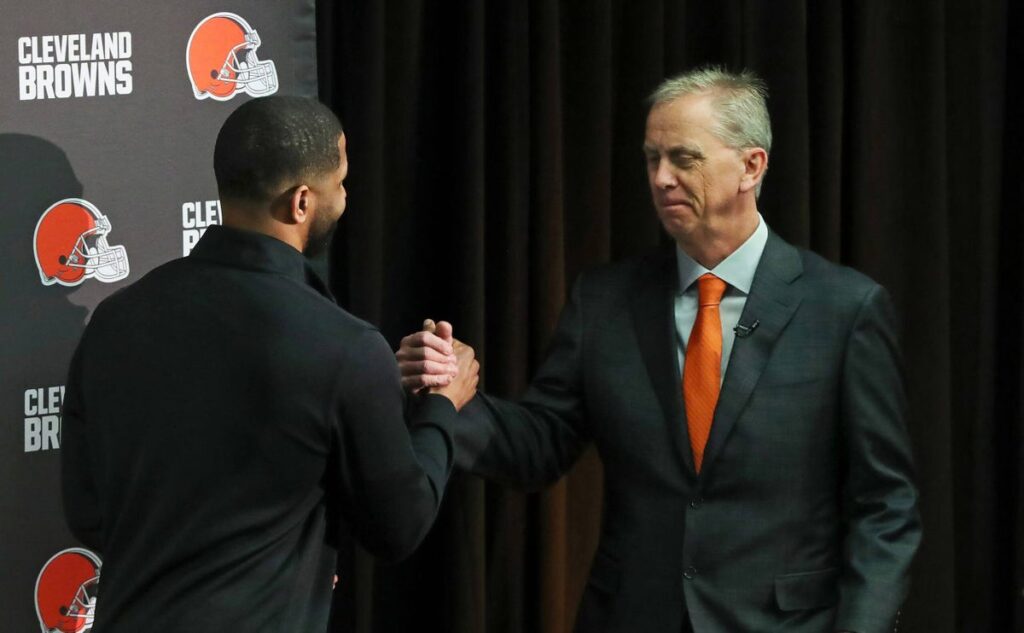
There’s a lot to consume after reporters spoke with team owner Jimmy Haslam, new coach Todd Monken and general manager Andrew Berry at the meetings. As Monken prepares for his first offseason program with the team, here’s a translation of what I heard and a few predictions for how some of the major issues could be addressed in the weeks and months ahead.
Shedeur Sanders should be first up
I know the folks atop the Browns’ organization publicly praised Deshaun Watson. I wholeheartedly believe there’s excitement for Watson getting healthy and trying to come back from his injuries and previous failures in Cleveland.
But I feel stronger than ever that Sanders, not Watson, is the favorite to win the starting job. Sanders is 24 and signed for three more seasons. He was never the team’s Plan A last season and might not be Plan A for the future, but giving Sanders every chance to win the job and make real progress is clearly the best option right now.
I think there will be a true competition. Based on the team’s history, it’s hard to predict much of anything. But the most direct path to the Browns escaping the Watson mess — every bit the “swing and miss” Haslam called it last year — is Sanders taking the job and providing at least league-average quarterback play for an evolving and talent-deficient offense.
Sanders felt he didn’t get a fair shake last spring and summer. As fourth in line, he never got the number of reps needed to make a strong impression. The time he missed last August due to an oblique strain ended any real chance he had to climb the depth chart — and there probably wasn’t much chance of that happening anyway.
But after being forced to play in November and going on to start the final seven games of his rookie season, this will be Sanders’ opportunity to take a real leap. He’s been working on getting stronger. Social media posts show he’s been throwing with teammates. The start of this offseason will provide Sanders with the chance to make real progress and become a more comfortable and confident player.
With the first month-plus of the offseason program mostly consisting of meetings, conditioning and drills, he can assert himself as a leader and work on mastering the new offensive system.
If Sanders puts his best foot forward, he’s the Browns’ best option for this summer and fall. I can’t predict what happens when the season begins, and there is a world in which Watson outplays Sanders to the point that the coaching staff actually believes Watson could truly elevate the offense.
But I think the job is Sanders’ to lose, and we’ll all soon see what twists and turns are encountered here in Chapter 19 of the Browns’ perpetual quarterback competition.
Let’s talk reality
Over his time in Cleveland, Watson has been neither healthy nor good. In 19 starts, he was good in maybe four of them. Maybe he and Kevin Stefanski were never a fit, and maybe Watson will actually stay healthy this time. The Browns are financially committed to him, so I understand the thought of giving him a shot to be the best man for the job.
But my own translation of Haslam saying Watson has a “great chance” is that he means Watson has earned the chance to return to football, compete again and maybe reboot his career for 2027 and beyond. The chances of Watson being with the Browns past this season are extremely low — and the level at which he would have to play to even be the best option for a rebuilding 2026 Browns team is a level he’s rarely performed at since 2020.
In the bigger picture, the Browns are tired of losing and believe they should have been better than they were last year. While it’s unlikely there’s any plan to outright tank the upcoming season, there’s also an understanding that this offense isn’t an immediate fix and that the best thing(s) going forward will be decisions eventually made about getting younger and adding future assets.
To reinforce the obvious: The upcoming draft is crucial to future progression and evaluation, regardless of which positions get immediate upgrades. Among the things I wonder, though: Is there some real internal belief in Sanders, Watson or a soon-to-be-drafted quarterback? Or is this a second straight season of just making up the plan as things go at the game’s most important position?
It didn’t make the headlines that other quotes did, but Monken said at the league meeting that he believes he’s assembled an “elite” offensive coaching staff. We’re all anxious to see how Monken goes about building this offense and what personnel upgrades are still on the way.
Myles Garrett’s future
I don’t believe the Browns want to trade Garrett — this year or any year, really. But the only explanation for the recent contract modification is that the Browns have sort of cleared a runway for a trade in the unlikely event that they feel it’s necessary and can get proper value in return. Garrett, at 30, is clearly the NFL’s most dominant defensive player.
After June 1, teams that believe they have the right quarterback and the right window to go for it may be prepared to make Godfather-like offers for Garrett. The Browns should then be prepared to ask for even more.
Cleveland’s willingness to even explore the possibility likely depends on how this impending quarterback competition goes, which direction the upcoming draft takes the Browns, and an honest assessment two to five months from now on the state of the offense and overall roster.
Garrett, obviously, could bring back a bunch of draft capital. But the Browns would need more than what might be the No. 30 pick in a future draft, and they’d only trade Garrett for an incredible return.
About the draft
It’s clear that the Browns’ best and likely preferred option in the draft is to trade down from either No. 6 or No. 24 in hopes of adding at least one additional second-day pick in either 2026 or 2027. It’s unlikely Cleveland would be able to find a deal in which it would acquire an extra 2027 first-rounder.
If the Browns can’t find a trade-down partner, I think they’ll take Ohio State wide receiver Carnell Tate at No. 6. If the Browns think an offensive lineman is the best player available at No. 6, but he isn’t a natural left tackle, they’ll take him and figure things out as they go.
I view the versatility added to the line in March as a plus — and also a reminder that the line is a multiyear rebuilding project. If the Browns take Miami tackle Francis Mauigoa, they could play him at right guard for a year (or part of a year) and then move him to right tackle, and either move Tytus Howard inside or over to left tackle.
Per TruMedia, 25 teams last season ended up getting fewer than 50 percent of the season snaps out of their Week 1 starting offensive line. The Browns, obviously, were part of that group, with three players making starts at left tackle and four making starts at right tackle.
At No. 24 (or after a trade down), the Browns could select a more natural left tackle, such as Utah’s Caleb Lomu or Georgia’s Monroe Freeling. From the outside looking in, drafting Tate then a tackle seems to fit. I feel confident that the Browns will take two offensive linemen among their first four picks, and I won’t be stunned if they take linemen with two of their first three selections.
For now, the Browns will more likely be in the business of selecting a mid-round quarterback project than they would be in taking Alabama’s Ty Simpson in the first round. But let’s see if they can trade out of No. 6 and add at least one more premium pick in either 2026 or 2027 before we go too far down the draft forecasting road.