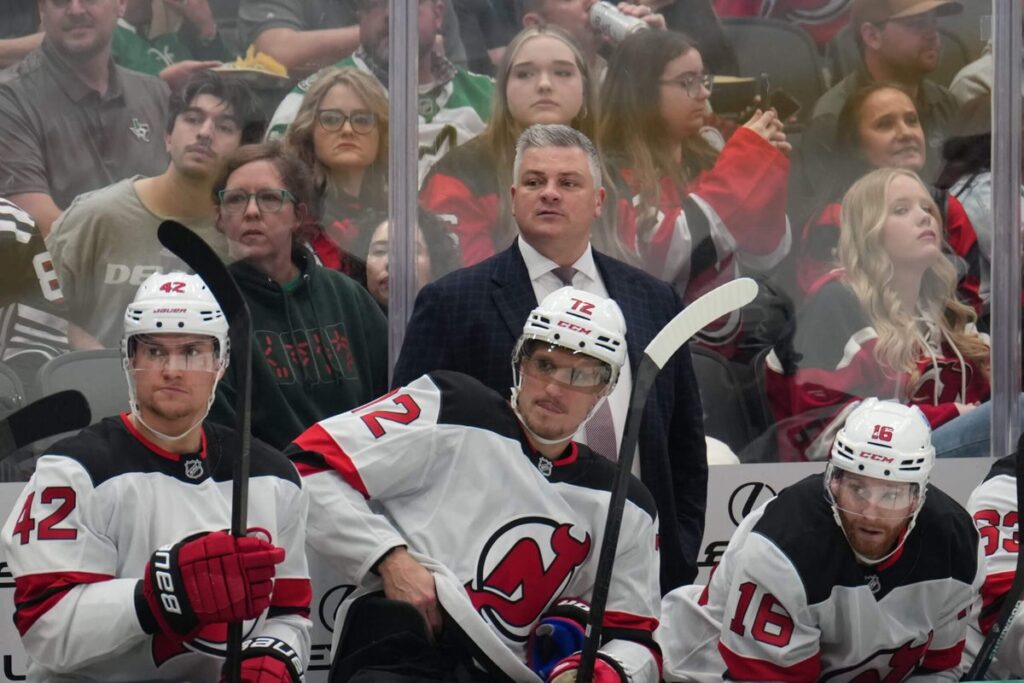

The New Jersey Devils answered one of their biggest questions entering the offseason on Monday, firing president of hockey operations Tom Fitzgerald.
Whomever the team hires next will inherit a core built around Jack Hughes and captain Nico Hischier: an appealing starting point. Though the Devils are a disappointing 40-34-3, they have the talent to contend for a playoff spot right away.
However, there’s still plenty to be done. Let’s dive into what the next general manager (or president of hockey operations, if the Devils opt for that management structure) must address early in their tenure.
Make a head coach decision
Fitzgerald hired Sheldon Keefe after the 2023-24 season. The coach had a 212-97-40 record over six seasons with the Toronto Maple Leafs, and he led New Jersey to the playoffs in his first season. The team finished 42-33-7 and lost in five games to Carolina in the first round.
Keefe has faced his fair share of challenges this season, namely navigating injuries to Hughes and defenseman Brett Pesce, but the Devils’ descent from a 13-4-1 start has been concerning. The next GM will have to make a call on how much the team’s midseason struggles were due to Fitzgerald’s roster and how much to the coach behind the bench.
Another factor will be the candidates available.
Bruce Cassidy, recently fired by Vegas, will presumably have a job as soon as he wants one. Other coaches will surely get fired when teams finish their seasons. Will any of those have appeal to the next Devils’ boss? Will they come in with a different candidate in mind? Or will they give Keefe a chance to show what he can do under a new administration?
Evaluate the core
The Devils have five players under 30 years old making at least $7 million: Hughes ($8 million average annual value through 2029-30), Hischier ($7.25 million; 2026-27), wings Jesper Bratt ($7.875 million; 2030-31) and Timo Meier ($8.8 million; 2030-31) and defenseman Luke Hughes ($9 million; 2031-32). Let’s consider those five as the core.
The Hughes brothers aren’t going anywhere. Jack became one of the faces of the sport after scoring the Golden Goal at the Olympics for Team USA, and he’s proven himself as one of the most offensively gifted players in the league when healthy. Luke has endured growing pains, but he’s still a 22-year-old defenseman playing top-pair minutes with all the necessary tools to succeed.
As long as Bratt and Hischier want to stay with the team, they will: Both have full no-movement clauses for the next three seasons.
Bratt, selected in the sixth round of the 2016 draft, has been a developmental success story for the Devils. He had a career-high 88 points in 2024-25, and though his production rate has dipped this season (68 points in 77 games), he is still on a team-friendly contract, especially with the salary cap rising.
New Jersey surely expected more from Meier when it acquired him at the 2023 trade deadline and extended him for eight years. He finished that year with 40 goals but hasn’t cracked 28 since. He’s at 24 goals and 42 points in 72 games this season — less-than-ideal production for the team’s highest-paid forward.
Further unlocking Meier must be a priority for Keefe (or whoever is coaching the Devils next season), but it’s hard to envision him not on the roster given his no-movement clause and contract.
That leaves Hischier, the captain. He’s 27, a strong two-way center capable of scoring 30-plus goals and finishing high in Selke Trophy voting. That’s not the type of player teams move on from. The only wrinkle to all this is that Hischier is extension-eligible this summer and entering the final year of his contract. Figuring out a new deal must be high on the next general manager’s to-do list.
The Devils’ core is likely one of the more appealing elements of the now-vacant general manager job. Major changes to it don’t seem likely, but a new presence could bring new ideas.
Fix the bottom six
Good, subtle moves will go a long way for the Devils, especially if you believe in their core players. This season, many of the depth forwards Fitzgerald bet on didn’t have quality seasons.
Fitzgerald signed veteran Luke Glendening to a one-year, $775,000 contract over the summer. The Devils ended up counting on him for 52 games, during which he had zero goals and four points. The team put him on waivers, and the Philadelphia Flyers claimed him.
The Devils also signed Evgenii Dadonov (one-year, $1 million) with hopes that he could either play in the top six, which would move other players down the lineup, or play in the bottom six himself. Injuries limited him to five games in the first half of the season, and he has only one goal and zero assists in 23 games.
Veteran Ondrej Palat, a major Fitzgerald signing in 2022, showed his age as his contract progressed, and the Devils had to attach a third- and sixth-round pick to get off his contract in a deal with the New York Islanders. Paul Cotter and Stefan Noesen, both acquired before the 2024-25 season, have both experienced statistical drop-offs from their first season in New Jersey, and Noesen underwent season-ending knee surgery in January.
Bottom-six forwards often aren’t flashy, but they are necessary. Fitzgerald had some hits, acquiring some in recent years — Connor Brown is a quality player, though he’s currently in the top six, and Cody Glass is a solid depth center. However, this season, many of the depth moves didn’t pan out.
It’s a major reason the team’s record is what it is. If the next general manager is going to succeed, they will need to identify better the bottom-six players who can provide productive minutes for the Devils and supplement the still-promising core.
Decide on the futures of Nemec, Hamilton
Two of the Devils’ key defensemen — Simon Nemec and Dougie Hamilton — have uncertain futures.
Nemec, the No. 2 pick in the 2022 draft, is a restricted free agent after this season. That could be a difficult negotiation, which perhaps led to the defenseman’s name coming up in trade rumors at the deadline. Colleague Pierre LeBrun reported that he garnered serious interest. If the new general manager is hesitant to give Nemec what he wants as an RFA — as Fitzgerald might have been — then he could surface again in trade talks. The Devils would certainly be able to get a package for him, but trading a 22-year-old defenseman with upside comes with risk. He could pop elsewhere.
At 32, Hamilton is 10 years older than Nemec. His numbers have dropped from when he finished sixth in Norris voting while with the Devils in 2022-23, and he’s under contract through 2027-28 at $9 million AAV. He has a 10-team trade list and a full no-movement clause that prohibits him from being put on waivers.
Hamilton’s agent, J.P. Barry, told LeBrun earlier this season that “there have been efforts to trade him going back to the draft last year. We have made it clear to the Devils that we will consider teams outside our list and other creative ways to get to a team that is mutually acceptable.”
The Devils made Hamilton a healthy scratch for a game in January, a move that Barry felt was calculated to single his player out.
With the cap going up, more teams might be better equipped to take on Hamilton’s contract this summer should the Devils still want to move him.
Look at goaltending
Fitzgerald locked in his successor for goaltending. He extended Jake Allen at a reasonable $1.8 million AAV but gave him a term through 2029-30 in exchange.
He also extended Jacob Markström through 2027-28 in November, a move that now looks a bit dicey. The 36-year-old has an .885 save percentage and has saved 0.36 goals above expected, which ranks 66th in the league, per Evolving-Hockey. Meanwhile, Allen is 18th with 21.69 and has a .905 save percentage.
Because of Markström and Allen’s contracts, the new general manager might not have much to do in this regard other than hope Markström bounces back and perhaps bring in a depth goalie as another option at training camp.