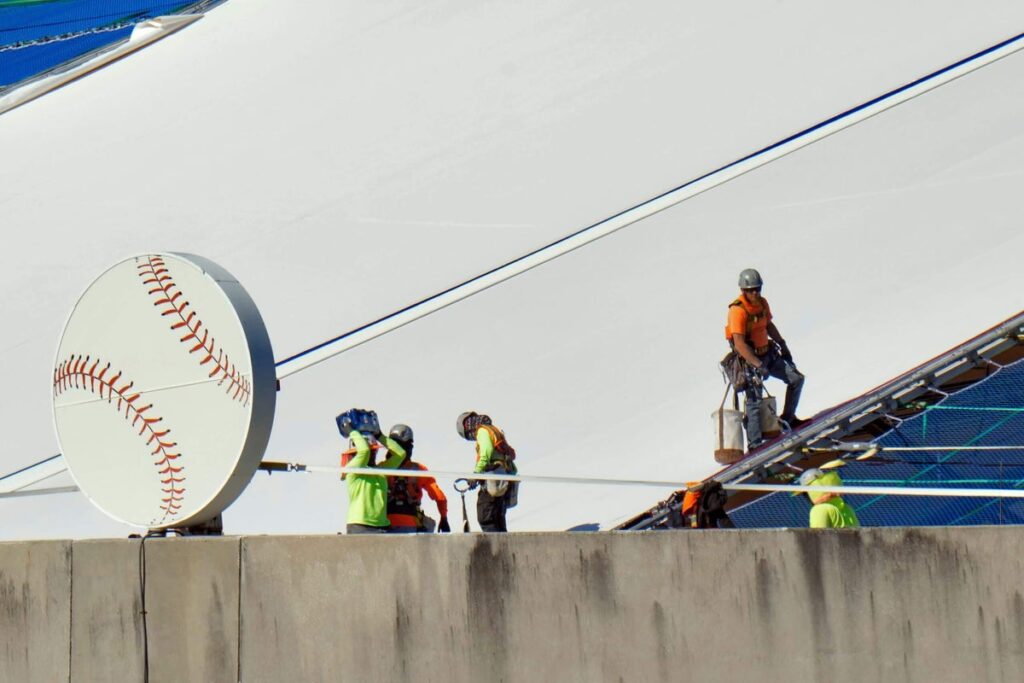

It’s been 18 months, almost to the day, since Hurricane Milton ripped the roof off Tropicana Field. The Tampa Bay Rays spent last season playing home games in a spring training stadium with another team’s logo on its seats. A $1.3 billion stadium deal fell apart, and the team was sold. The Rays’ perpetually uncertain future had never been in murkier waters.
Monday, then, will be a triumph regardless of the final score.
The Rays are returning to Tropicana Field for their first proper home game since September 2024. The city of St. Petersburg spent nearly $60 million to refurbish the ballpark — the roof is new, the turf is new, the lights are new — and the Rays modernized the facility with new equipment, expanded fitness and recovery spaces, and updated suites and amenities.
First pitch will be a hard-fought milestone.
It will also be a temporary fix.
“From a player perspective, I think the Trop will be a very welcome return home,” Rays CEO Ken Babby said. “But it is not a long-term home.”

Hurricane Milton ripped the roof fully off Tropicana Field and damaged the interior as well. (Kirby Lee / Getty Images)
Even as the Rays celebrate their return to Tropicana Field, their ownership group is aggressively pursuing a $2.3 billion proposal to build a new stadium in nearby Tampa, with the team paying half and the other half coming from public funds; that $1.15 billion would be the largest public ask for a baseball stadium, and one of the largest across any sport. The Rays counter that their private investment would be the second-most for any MLB project, and that they would cover any overages beyond the initial 50/50 split. The proposed ballpark — its renderings show the roof and walls made largely of glass — would sit within a 130-acre development that could cost upward of $10 billion. The Rays see the new stadium as a centerpiece of a massive, mixed-use complex that would become a hub of sports and entertainment in Tampa Bay.
“This is our Baltimore moment,” Babby said at a public event meant to generate support for the project in early March.
In 1992, Baltimore opened Camden Yards, the Orioles’ home ballpark that became one of the city’s main attractions. Even now, Camden Yards stands as a triumph. It was a model for nearly every new ballpark that followed, and the city of Baltimore just committed $135 million to maintain and upgrade the stadium. Maryland governor Wes Moore called it “symbolic of a city and state on the rise.”
Tropicana Field has been symbolic of something else.
Opened just two years before Camden Yards, the Trop became almost immediately a relic of the distant past. Originally called the Florida Suncoast Dome, the facility was built to attract a baseball team and hosted several other sports — including, for three seasons, the NHL’s Tampa Bay Lightning — before the expansion Rays played their inaugural season in 1998.
With its indoor quirks and minimal neighborhood development, the stadium has long been a source of consternation and occasional ridicule as the Rays struggled with low attendance and a minimal payroll, even as they competed with bigger-spending teams of the American League East. The team’s previous owner, Stuart Sternberg, bought the Rays for $200 million in 2004 and spent two decades trying to find a new home for the team. His last attempt to build a new stadium in St. Petersburg fell apart after Hurricane Milton decimated the area and damaged the Trop in October 2024.
Just weeks after the St. Petersburg stadium deal crumbled, Sternberg sold the Rays for roughly $1.7 billion to an investment group led by developer Patrick Zalupski. At his introductory press conference in October — which the Rays held at George M. Steinbrenner Field, the Yankees’ spring training facility that became the temporary Rays home in 2025 — Zalupski made clear his desire to create a partnership of public and private funds to build a new ballpark within three years.
“To be clear,” Zalupski said, “it is our first and highest priority to find that home here in Tampa Bay.”
As he spoke, Zalupski was a deep fly ball away from the site that ultimately became the focus of the Rays’ current stadium proposal: the campus of Hillsborough Community College on Dale Mabry Highway.
Dale Mabry is a busy thoroughfare four miles west of downtown Tampa, and the college campus sits along the road, right next to Steinbrenner Field and across from Raymond James Stadium, home of the NFL’s Tampa Bay Buccaneers. In choosing that site, the Rays have crafted an ambitious and perhaps unique proposal to integrate the college into a ballpark village.
The plan is to create a massive complex similar to The Battery in Atlanta but nearly twice as large. The site would include not only the new stadium but also shopping, housing and entertainment, all connected to a new Hillsborough College campus. Hillsborough College leadership has said it needs significant investment to repair and upgrade existing buildings. The state of Florida has donated a plot of land to Hillsborough College for use as part of the new site. The Rays say that they and private investors would finance all of the mixed-use development around the ballpark and put money toward the college construction.
“This isn’t just a ballpark,” Babby said at an on-campus event in March, the first of several public Q&A events. “It’s a district, a destination, a community asset.”
The Rays refer to the plan as their “forever home” but insist that time is of the essence to get it done. Their use agreement at Tropicana Field runs through 2028, and they want their new ballpark to be fully operational — from breaking ground to the first breaking ball — by Opening Day, 2029.
Hillsborough College has already approved a memorandum of understanding — basically, agreeing to the framework of a deal — and now the Rays are waiting for the Tampa City Council and Hillsborough County Commission to do the same. Those votes could come by the end of the month, and so the Rays ownership group has been making its sales pitch throughout the region.
As of this weekend, there was no memorandum of understanding in front of the city council or county commission, but the broad strokes of a potential agreement have been discussed publicly for months. The $1.15 billion in public funding has been controversial, with some city and country residents concerned about the use of tax money to build a ballpark, and others questioning the specific funding sources that the Rays and county officials have been discussing.
At the public Q&A event in March, some residents expressed concern about the influx of people and traffic into the area, and others questioned why alternate sites — including in the historic Ybor City neighborhood — were ultimately not pursued (Babby said the Hillsborough location better fit the team’s vision and timeline). Various Hillsborough College students expressed concerns about their disrupted college experience. While the school’s dormitories will not be affected, much of campus life would move to a temporary site while the buildings are reconstructed.
The Rays, in making their case for public funds, have argued that the economic impact will be a net gain for the city. As the stadiums built in the 1990s begin to show their age, owners in various MLB cities are looking for new buildings, nearly always with a public funding component; numerous studies have shown that these projects rarely, if ever, live up to promises that they will pay for themselves.
“Studies consistently demonstrate that sports stadiums have little to no tangible economic impacts on host communities, and thus typical public subsidies tend to exceed any meager economic benefits they may provide,” John Charles Bradbury, Dennis Coates, and Brad Humphreys wrote in their 2023 paper, “The Economics of Stadium Subsidies:
A Policy Retrospective.”

The Rays turned Steinbrenner Field, the spring training site of the New York Yankees, into their temporary home in 2025.
The Yankees, whose spring training complex would abut the new development, have expressed support for the project. Last week, the Tampa Sports Authority voted to approve additional money to study the proposed ballpark’s roof, but also requested additional information before giving the project its full endorsement.
“I believe that we’re probably 80 percent there,” Tampa City Council and TSA member Alan Clendenin told the local NBC affiliate.
The Hillsborough County Commissioners next meet on April 15, and the Tampa City Council next meets on April 16. It’s possible a memorandum of understanding could be voted upon at those two meetings, a potentially pivotal 24 hours for the project and the franchise. There still would be details and contractual language to finalize, but a positive vote on an MOU would leave all parties confident that the deal is moving forward.
Until they have their forever home, though, the Rays have Tropicana Field.
Front-office staff moved back into the ballpark in early March, and although plans for a media walkthrough at the end of spring training were put on hold, the MLB schedule has been set for months. The Rays are the last team to play a home game; They opened with an 11-day road trip before Monday’s 4:10 pm ET home opener against the Chicago Cubs.
By shredding the fiberglass dome, Hurricane Milton exposed Tropicana Field in ways that were never intended, and the ballpark required far more than a new 24-panel roof. Much of the internal stadium had to be repaired, and ownership took the opportunity to modernize player facilities and fan amenities. According to Babby, the clubhouses have been redone, modern training equipment has been installed, and fitness and recovery spaces have been expanded. There is new paint throughout the building, suites have been updated, and the fourth-floor Baldwin Group Club has been redesigned. A new home plate club includes a speakeasy and old-fashioned craft candy shop — the sort of unique details found in other modern major-league ballparks.
“The building looks better than it ever has,” Babby said.
This may very well be the Trop’s finest hour, but its days as a major-league ballpark are almost certainly numbered. Babby said ownership views the restoration of Tropicana Field as a sign of its devotion to the franchise and an example of its vision for the future, but he also talked about “25 years of fatigue” surrounding the future of the Rays and their ballpark. It took a natural disaster to bring that issue to a head, and the Rays are now repairing their past, playing for the present, and trying to address their future once and for all.
Baseball is back at Tropicana Field. At least, for now.
“It will be great to be back in there,” Babby said. “It will be special for our fans and great for our team. But we are focused on our forever home.”