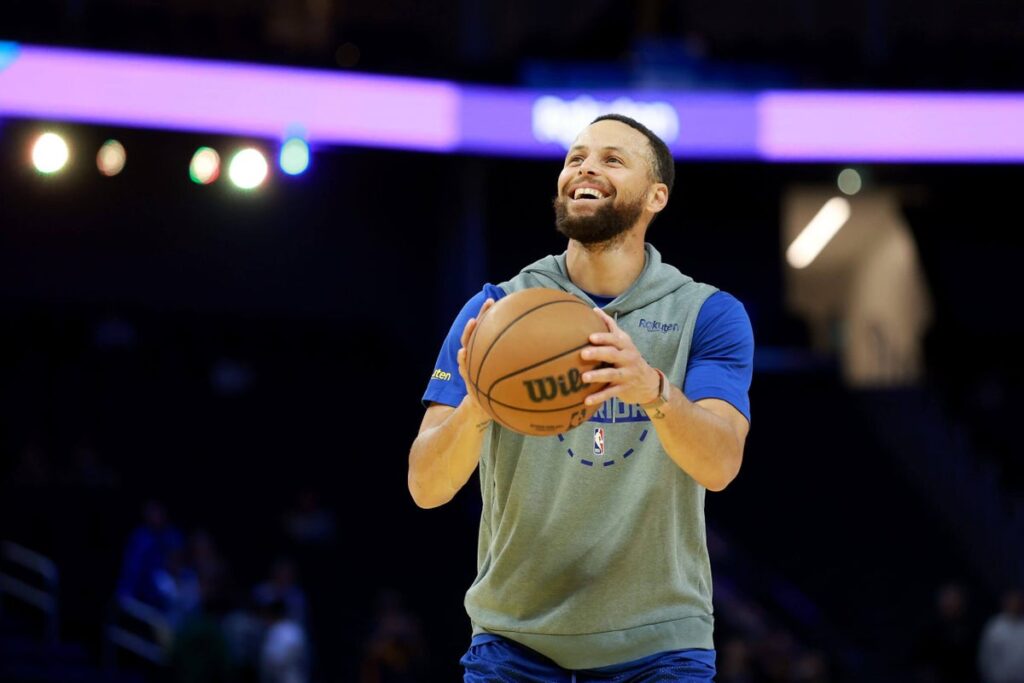

SAN FRANCISCO — The home team’s baseline at Chase Center has been a place of ample space and solitude ever since Steph Curry went down with a right knee injury two months ago.
The television folks who broadcast Golden State Warriors games from their designated spots next to the court have had all sorts of elbow room with which to work. The noise level has been low, allowing clear on-air audio and courtside conversations to take place without distraction. Team staffers, so accustomed to controlling huge crowds of fans and media members who religiously show up 80 minutes before tipoff to watch the greatest pregame show on earth, have reported lower stress levels while on the job.
Yet as pleasant as the serene scene might seem, this was not a good thing — for the Warriors or the NBA. To see Curry return to his famed pregame ways on Wednesday night was to be reminded that the debate about whether he should bother coming back this season is so utterly silly.
Anyone who believes that Golden State should be tanking rather than welcoming No. 30 back with open arms should be required to sit courtside for one of these pregame spectacles. The 38-year-old hadn’t even returned for real yet — sources told The Athletic this week that he’s targeting Sunday’s game against the Houston Rockets for the official comeback — and the energy shifted in the kind of way that should help explain why Curry didn’t want to wave the white flag on this season. That collective mood change was evident before tipoff against the San Antonio Spurs, when the baseline buzz — and the crowded hordes of cell phone videographers who come with it — was back in full force.
An entertainer was entertaining. Imagine that.
Of all the ways that Curry’s unique impact has been felt in these past 17 seasons, from the Oakland days at Oracle Arena to the Chase Center experience that began when they crossed the Bay in 2019, this storied part of his routine has been perhaps the most charming and unique. It is, in essence, a joyful tribute to his wondrous skills and his connection with the adoring public. It takes a special sort of talent to dazzle the gathered masses without even logging a minute of playing time, yet Curry — for the first time since he went down in a home game against Detroit on Jan. 30 — did just that.
Not long before all that courtside chaos, Warriors coach Steve Kerr — whose 10th-place team (36-40) fell to 9-17 without its franchise centerpiece after losing 127-113 to San Antonio — made it clear why the idea of sitting Curry when he is finally healthy simply didn’t compute.
“I don’t know,” Kerr began when asked to explain why the Warriors, who have their 2026 first-round pick, have chosen not to tank. “That’s not — not what we do. Just compete. That’s the job. And Steph’s in the final stages of his career. If he has a chance to be in the playoffs, he’s gonna want to (compete), and our group’s gonna wanna too.”
It really is that simple, even if a fair amount of media members and fans insist that it’s not. The season-ending injuries to Jimmy Butler and Moses Moody, along with the roller coaster experience with newcomer Kristaps Porziņģis, shouldn’t change this calculus. Nor should the fact that this once-proud dynasty now finds itself scratching and clawing to remain part of the playoff picture. So long as there is meaningful basketball left to be played — and yes, a third consecutive Play-In Tournament opportunity qualifies — then the Basketball Gods demand that you resist whatever temptation there might be to marginally improve the chances of improving your pick.
Considering the most recent precedent, how the Warriors took the Play-In route last season before downing Houston in the first round (and then falling to the Minnesota Timberwolves when Curry went down with a hamstring strain), no one should be surprised that he still sees hope in this route. Better yet, has everyone forgotten how this man went from struggling throughout the Paris Olympics two summers ago to becoming the savior at the end in Team USA’s gold-medal run? He should never — I repeat, never — be denied access to a court if he’s ready to run.
In the bigger picture sense, the pressure that Father Time is applying to Curry’s timeline is clearly a bigger priority to the Warriors than their lottery odds — and rightly so. The fact that this is even a question is a sign of the league’s larger problem.
Everywhere you look these days, teams are sacrificing the good of the game for the chance to lose their way into a few more lottery balls. This is why significant change is coming soon, with commissioner Adam Silver declaring at the league’s Board of Governors meetings last week that “We are going to fix it — full stop.”
The irony of the Spurs being in town was that San Antonio’s 22-year-old phenom, Victor Wembanyama, knows as well as anyone that every opportunity to compete needs to be cherished. That was the lesson Wembanyama learned last season, when a blood clot ended his season early and reminded him that playing this game is a privilege that should be treated as such. In short, superstar players are simply too special to be shelved — no matter the surrounding circumstances (cc: the Milwaukee Bucks).
Before Curry got injured, he was producing at an elite pace (27.4 points, 4.8 assists, 3.5 rebounds per game) and on track to become one of 12 players to have at least 12 All-NBA appearances (LeBron James has the all-time mark of 21; Michael Jordan had 11). So, yes, in other words, the Warriors’ choice to streamline his return is well advised.
As was his pregame routine that was nothing short of a sneak preview.
“That was purposeful,” Kerr said of Curry’s choice to share his routine with the fans for the first time in two months. “Instead of shooting downstairs, he wants to feel the crowd and show the crowd. He wants to come back, so that’s the hope.”
And with good reason.