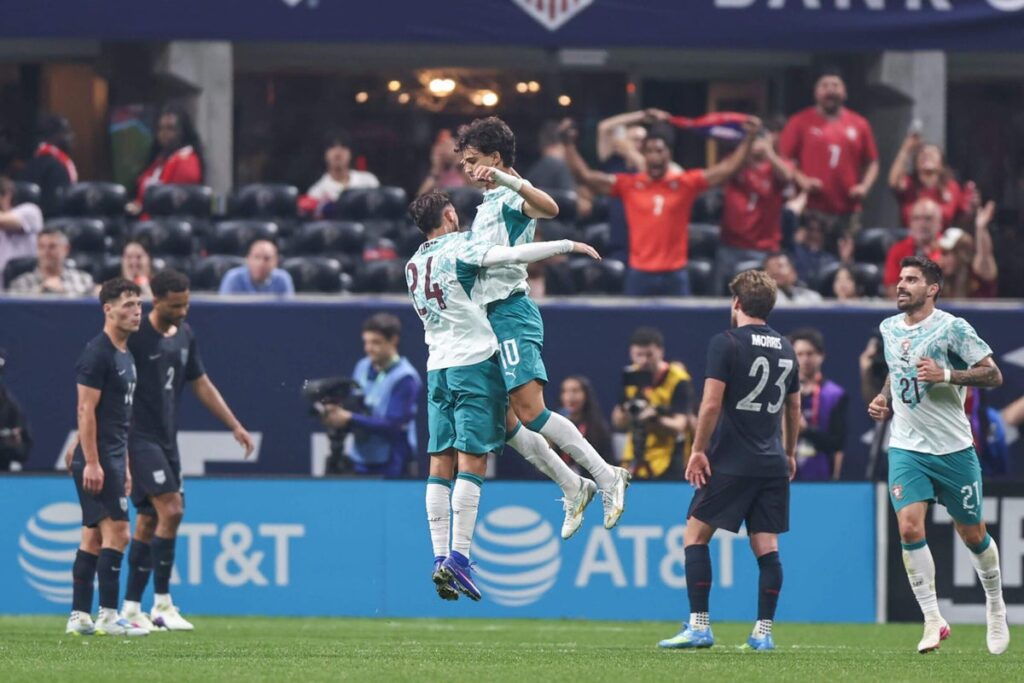

ATLANTA — When Mauricio Pochettino gathered his U.S. men’s national team players on the first full day of a crucial March training camp, he spoke to them about belief. He exuded a calm confidence that built around the U.S. team this fall, that swept up fans who dared to dream. They talked then about doing “the impossible,” about charging deeper into a men’s World Cup than ever before. Now, standing on a training pitch outside Atlanta last week, Pochettino asked his players: “Why not us?”
And on Saturday and Tuesday, Belgium and Portugal delivered answers.
The answer was Vitinha’s pass to Bruno Fernandes on Tuesday night. It was Jérémy Doku’s electrifying 1-v-1 ability three days earlier. It was, in Pochettino’s words, “small details,” the type that separated the USMNT and European powers over the past week — and over the past decade.
“Why not us?”
Well, to win a World Cup, you almost certainly have to beat multiple top-10 European teams. And the U.S. hasn’t beaten one in nearly 11 years.
It has now lost eight straight games to European nations, regardless of rank, the second-longest such streak in program history, per TruMedia. And it is winless in 10 World Cup matches against teams from the continent since 2002.
The U.S. believed, and players insist they still do. But they also made minor mistakes Saturday and Tuesday — mistakes that go unnoticed against lowly Concacaf teams but get punished by the likes of Portugal and Belgium. It’s a lagging recovery run. It’s a foolish pass or a poor first touch. It’s a jump into the wrong passing lane. It’s Antonee Robinson cheating too high, plus a half dozen other “details” that allowed Portugal to take a 1-0 lead.
“In that situation, we need to read [the game] better,” Pochettino said of the sequence that led to the first Portuguese goal in a simple 2-0 win.
“This type of mistakes, they are not crazy,” he continued. “But in this type of game, players like [Pedro] Neto, [Gonçalo] Ramos, Bruno, João Félix — when you give a centimeter, it’s possible that they can score. That was what happened.”

João Félix’s world-class ability made an impact against the United States. (Rich von Biberstein / Icon Sportswire / Getty Images)
That’s what happened Tuesday. That’s what happened Saturday. That’s what happened last June against Switzerland. It also happened in 2023 against Germany, and at the 2022 World Cup against the Netherlands.
For extended stretches of some of those games, the USMNT was competitive. It was better than Belgium for 40 minutes. It was on the front foot for 20 against Portugal. It looked like a coherent, well-coached team. It played with confidence and even attitude, just as it had for spells against the Germans and Dutch years ago.
What it lacked was top-end talent. Individual quality. Pochettino essentially said this Tuesday.
“We are USA. And we are competing against Belgium, Portugal,” he said. “For sure, Belgium and Portugal have, in the top 100 players [in the world], a few or some players in that top 100. I think we don’t have.”
That, of course, is an oversimplified view of soccer, a wonderfully complex sport. Underdogs beat favorites all the time. Intensity and organization, intangibles and tactics, randomness and luck can all close quality gaps on any given day. They have for U.S. men’s national teams in the past. Someday, they’ll do so again.
But it’s been a damn long time since the USMNT sustained them for 90 minutes. And at the final whistle Tuesday, shoulders sank. Heads hung. Bodies moped. Chris Richards tugged at his jersey in frustration.
Pochettino, when asked if he worried that the players would lose belief, seemed perplexed by the concept.
“Who start to lose belief? Which players?” he asked.
When told that none of them had ever beaten a top European team, he responded: “Yeah, but always it’s — hope the first time is going to be in the World Cup. We need to learn. That is why we are playing this type of game.”

Manager Mauricio Pochettino gives a miffed reaction as the U.S. fell to Portugal in Atlanta (Andrew J. Clark / ISI Photos / USSF / Getty Images)
The players, for their part, said they are indeed learning. Some have hardly seen this level before. The USMNT’s schedule is now largely filled by games within Concacaf.
When they met the likes of Portugal, Auston Trusty saw “the ruthlessness of the finishing.”
Sebastian Berhalter felt, for the first time, a different type of soccer. “When you play against these teams, it’s a lot less chaotic than you would think,” he said. “It’s a lot more controlled. Guys have great first touches, so, pressing, it makes it even harder.”
The U.S. did press effectively up until the game’s first hydration break. That, and the entire first half, fueled the players’ persistent belief.
“I mean, both first halves, we caused the teams a lot of problems, we put a lot of pressure on them,” Christian Pulisic said of Belgium and Portugal. “It didn’t seem like either game was out of control.”
The shortcoming, he acknowledged, was “just little moments, or being a little bit more clinical. It’s just the same story. But I feel really close. I feel like we’re in a good place.”

USMNT players have two more matches before the World Cup group stage (Omar Vega / USSF / Getty Images)
In that sense, their belief is totally valid and logical. In both games this month, just like against the Netherlands in 2022, they can point to moments, to specific chances that, if they’d been converted, could have led to very different conclusions. They are, or at least seem, within reach of international soccer’s upper echelons. It would be foolish to say they cannot beat Germany in June or Turkey at the World Cup or someone even better in the knockout stages.
But it was also impossible to escape the feeling that Portugal was toying with the U.S. — just like Germany and the Netherlands did a few years ago.
And it was hard to see how the U.S. would beat a team of that caliber. The Americans can, but there is increasingly little reason to believe they will.
Late last week, after repeating his “why not us” line to reporters, Pochettino was asked: Why? Can you sell to the average American why the U.S. is a contender for the World Cup?
The crux of his answer was: “Because we are American.”
And on Tuesday night, after all the momentum from the fall had fizzled, although he repeatedly reiterated a positive message, the belief felt a bit more like blind faith.
“When we match the opponent in the areas that we need to match,” Pochettino said, “for sure we are going to have the possibility to beat them.”
Pulisic concluded: “We’re gonna figure it out. We’re gonna figure it out when it really counts.”